Infrequently NotedAlex Russell on browsers, standards, and the process of progress.2024-03-10T00:00:00Zhttps://infrequently.orgAlex Russellalex@infrequently.orgWhy Browsers Get Built2024-03-10T00:00:00Zhttps://infrequently.org/2024/03/why-browsers-get-built/Like Platform Adjacency Theory and The Core Web Platform Loop, this post started[1] as a set of framing devices that I've been sketching on whiteboards for the best part of a decade. These lenses aren't perfect, but they provide starting points for thinking about the complex dynamics of browsers, OSes, "native" platforms, and the standards-based Web platform.
There are only two-and-a-half reasons to build a browser, and they couldn't be more different in intent and outcome, even when they look superficially similar. Learning to tell the difference is helpful for browser project managers and engineers, but also working web developers who struggle to develop theories of change for affecting browser teams.
The reasons to build browsers are most easily distinguished by the OSes they support and the size and composition of their teams ("platform" vs. "product"). Even so, there are subtleties that throw casual observers for a loop. In industrial-scale engineering projects like browsers headcount is destiny, but it isn't the whole story.
This is simultaneously the simplest and most vexing reason to build a browser.
Under this logic, browsers are strategically important to a broader business, and investments in platforms are investments in their future competitiveness compared with other platforms, not just other browsers. But none of those investments come good until the project has massive scale.
The idea is that the web is where the action is, and that the browser winning more user Jobs To Be Done follows from increasing the web platform's capability. This developer-enabling flywheel aims to liberate computing from any single OS, supporting an ephemeral services model of computing.
There are two primary tactical modes of this strategic posture, both serving the same goal: to make an operating system look good by enabling a corpus of web content to run well on it while maintaining a competitive distance between the preferred (i.e., native, OS-specific) platform and the hopefully weaker web platform.
The two sub-variants differ in ambition owing to the market positions of their OS sponsors.
OSes deploy browsers as a bridge for users into their environment when they're underdogs or fear disruption.
Of course, it would be better from the OS vendor's perspective if everyone simply wrote all of the software for their proprietary platform, maximising OS feature differentiation. But smart vendors also know that's not possible when an OS isn't dominant.
OS challengers, therefore, strike a bargain. For the price of developing a browser, they gain the web's corpus of essential apps and services, serving to "de-risk" the purchase of a niche device by offering broad compatibility with existing software through the web. If they do a good job, a conflicted short-term investment can yield enough browser share to enable a future turn towards moat tactics (see below). Examples include Internet Explorer 3-6 as well as Safari on Mac OS X and the first iPhone.
Conversely, incumbents fearing disruption may lower their API drawbridges and allow the web's power to expand far enough that the incumbent can gain share, even if it's not for their favoured platform; the classic example here being Internet Explorer in the late 90s. Once Microsoft knew it had Netscape well and truly beat, it simply disbanded the IE team, leaving the slowly rusting husk of IE to decay. And it would have worked, too, if it weren't for those pesky Googlers pushing IE6 beyond what was "possible"!
Without meaningful regulation, powerful incumbents can use anti-competitive tactics to suppress the web's potential to disrupt the OS and tilt the field towards the incumbent's proprietary software ecosystem.
This strategy works by maintaining high browser share while never allowing the browser team to deliver features that are sufficient to disrupt OS-specific alternatives.
In practice, moats are arbitrage on the unwillingness of web developers to understand or play the game, e.g. by loudly demanding timely features or recommending better browsers to users. Incumbents know that web developers are easily led and are happy to invent excuses for them. It's cheap to add a few features here an there to show you're "really trying", despite underfunding browser teams so much they can never do more than a glorified PR for the OS. This was the strategy behind IE 7-11 and EdgeHTML. Even relatively low share browsers can serve as effective moats if they can't be supplanted by competitive forces.
Apple has perfected the moat, preventing competitors from even potentially offering disruptive features. This adds powerfully to the usual moat-digger's weaponisation of consensus processes. Engineering stop-energy in standards and quasi-standards bodies is nice and all, but it is so much more work than simply denying anyone the ability to ship the features that you won't.
Bridge and moat tactics appear very different, but the common thread is control with an intent to suppress web platform expansion. In both cases, the OS will task the browser team to heavily prioritise integrations with the latest OS and hardware features at the expense of more broadly useful capabilities — e.g. shipping "notch" CSS and "force touch" events while neglecting Push.
Browser teams tasked to build bridges can grow quickly and have remit that looks similar to a browser with a platform agenda. Still, the overwhelming focus starts (and stays) on existing content, seldom providing time or space to deliver powerful new features to the Web. A few brave folks bucked this trend, using the fog of war to smuggle out powerful web platform improvements under a more limited bridge remit; particularly the IE 4-6 crew.
Teams tasked with defending (rather than digging) a moat will simply be starved by their OS overlords. Examples include IE 7+ and Safari from 2010 onward. It's the simplest way to keep web developers from getting uppity without leaving fingerprints. The "soft bigotry of low expectations", to quote a catastrophic American president.
This is the "half-reason"; it's not so much a strategic posture as it is environment-surfing.
Over the years, many browsers that provide little more than searchboxes atop someone else's engine have come and gone. They lack staying power because their teams lack the skills, attitudes, and management priorities necessary to avoid being quickly supplanted by a fast-following competitor pursuing one of the other agendas.
These browsers also tend to be short-lived because they do not build platform engineering capacity. Without agency in most of their codebase, they either get washed away in unmanaged security debt, swamped by rebasing challenges (i.e., a failure to "work upstream"). They also lack the ability to staunch bleeding when their underlying engine fails to implement table-stakes features, which leads to lost market share.
Historical examples have included UC Browser, and more recently, the current crop of "secure enterprise browsers" (Chromium + keyloggers). Perhaps more controversially, I'd include Brave and Arc in this list, but their engineering chops make me think they could cross the chasm and choose to someday become platform-led browsers. They certainly have leaders who understand the difference.
This model isn't perfect, but it has helped me tremendously in reliably predicting the next moves of various browser players, particularly regarding standards posture and platform feature pace.[2]
The implications are only sometimes actionable, but they can help us navigate. Should we hold out hope that a vendor in a late-stage browser-as-moat crouch will suddenly turn things around? Well, that depends on the priorities of the OS, not the browser team.
Similarly, a Web As Platform strategy will maximise a browser's reach and its developers' potential, albeit at the occasional expense of end-user features.
The most important takeaway for developers may be what this model implies about browser choice. Products with an OS-first agenda are always playing second fiddle to a larger goal that does not put web developers first, second, or even third. Coming to grips with this reality lets us more accurately recommend browsers to users that align with our collective interests in a vibrant, growing Web.
I hadn't planned to write this now, but an unruly footnote in an upcoming post, along with Frances' constant advice to break things up, made me realise that I already had 90% of it of ready. ↩︎
Modern-day Mozilla presents a puzzle within this model.
In theory, Mozilla's aims and interests align with growing the web as a platform; expanding its power to enable a larger market for browsers, and through it, a larger market for Firefox.
In a sense, it's playing the OS Agenda, but without an OS to profit from or a proprietary platform to benefit with delay and deflection. This is vexing, but perhaps expected within an organisation that has entered a revenue-crunch crouch. Another way to square the circle is to note that the the Mozilla Manifesto doesn't actually speak about the web at all. If the web is just another fungible application running atop the internet (which the manifesto does center), then it's fine for the web to be frozen in time, or even shrink.
Still, Mozilla leadership should be thinking hard about the point of maintaining an engine. Is it to hold the coats of proprietary-favouring OS vendors? Or to make the web a true competitor? ↩︎
Update: OWA is out with an open letter appealing to Apple to do better. If you care about the future of the web, I encourage you to sign it, particularly if you live in the EU or build products for the common market.
After weeks of confusion and chaos, Apple's plan to kneecap the web has crept into view, menacing a PWApocalypse as the March 6th deadline approaches for compliance with the EU's Digital Markets Act (DMA).
The view from Cupertino.
The DMA requires Apple to open the iPhone to competing app stores, and its lopsided proposal for "enabling" them is getting most of the press. But Apple knows it has native stores right where it wants them. Cupertino's noxious requirements will take years to litigate. Meanwhile, potential competitors are only that.
But Cupertino can't delay the DMA's other mandate: real browsers, downloaded from Apple's own app store. Since it can't bar them outright, it's trying to raise costs on competitors and lower their potential to disrupt Apple's cozy monopoly. How? By geofencing browser choice and kneecapping web apps, all while gaslighting users about who is breaking their web apps.
The immediate impact of iOS 17.4 in the EU will be broken apps and lost data, affecting schools, governments, startups, gamers, and anyone else with the temerity to look outside the one true app store for even a second. None of this is required by the DMA, as demonstrated by continuing presence of PWAs and the important features they enable on Windows and Android, both of which are in the same regulatory boat.
The data loss will be catastrophic for many, as will the removal of foundational features. Here's what the landscape looks like today vs. what Apple is threatening:
Apple's support for powerful web apps wasn't stellar, but this step in the wrong direction will just so happen to render PWAs useless to worldwide businesses looking to reach EU users.
Apple's interpretation of the DMA appears to be that features not available on March 6th don't need to be shared with competitors, and it doesn't want to share web apps. The solution almost writes itself: sabotage PWAs ahead of the deadline and give affected users, businesses, and competitors minimal time to react.
Cupertino's not just trying to vandalise PWAs and critical re-engagement features for Safari; it's working to prevent any browser from ever offering them on iOS. If Apple succeeds in the next two weeks, it will cement a future in which the mobile web will never be permitted to grow beyond marketing pages for native apps.
By hook or by crook, Apple's going to maintain its home screen advantage.
If you'd like to stop reading here, take with you the knowledge that Cupertino's attempt to scuttle PWAs under cover of chaos is exactly what it appears to be: a shocking attempt to keep the web from ever emerging as a true threat to the App Store and blame regulators for Apple's own malicious choices.
The last-minute unveil and months of radio silence were calculated to give competitors minimal time to react to the complex terms, conditions, and APIs. This tactic tries to set Apple's proposal as a negotiating baseline, forcing competitors to burn time and money arguing down plainly unacceptable terms before they can enter the market.
Apple's message of hope and optimism for a better web.
The proposals are maximally onerous, but you don't have to take my word for it; here's Mozilla:
We are ... extremely disappointed with Apple’s proposed plan to restrict the newly-announced BrowserEngineKit to EU-specific apps. The effect of this would be to force an independent browser like Firefox to build and maintain two separate browser implementations — a burden Apple themselves will not have to bear.
Apple’s proposals fail to give consumers viable choices by making it as painful as possible for others to provide competitive alternatives to Safari.
This is another example of Apple creating barriers to prevent true browser competition on iOS.
The strategy is to raise costs and lower the value of porting browsers to iOS. Other browser vendors have cited exactly these concerns when asked about plans to bring their best products to iOS. Apple's play is to engineer an unusable alternative then cite the lack of adoption to other regulators as proof that mandating real engine choice is unwise.
Instead of facilitating worldwide browser choice in good faith, Apple's working to geofence progress; classic "divide and conquer" stuff, justified with serially falsified security excuses. Odious, brazen, and likely in violation of the DMA, but to the extent that it will now turn into a legal dispute, that's a feature (not a bug) from Apple's perspective.
It's challenging, verging on impossible, to read this as anything but extrordinary bad faith, but Apple's tactics require context to understand.
The DMA came into force in 2022, putting everyone (including Apple) on notice that their biggest platforms and products would probably be "designated", and after designation, they would have six months to "comply". The first set of designation decisions went out last Sept, obligating Android, Windows, iOS, Chrome, and Safari to comply no later than March 6th, 2024.
A maximally aggressive legal interpretation might try to exploit ambiguity in what it means to comply and when responsibilities actually attach.
Does compliance mean providing open and fair access starting from when iOS and Safari were designated, or does compliance obligation only attach six months later? The DMA's text is not ironclad here:
10: The gatekeeper shall comply with the obligations laid down in Articles 5, 6 and 7 within 6 months after a core platform service has been listed in the designation decision pursuant to paragraph 9 of this Article.
Firms looking to comply maliciously might try to remove troublesome features just before a compliance deadline, then argue they don't need to share them with competitors becuse they weren't available before the deadline set in. Apple looks set to argue, contra everyone else subject to the DMA, that the moment from which features must be made interoperable is the end of the fair-warning period, not the date of designation.
This appears to be Apple's play, and it stinks to high heavens.
Apple's change isn't merely cosmetic. In addition to immediate data loss, FruitCo's change will destroy:
App-like UI: Web apps are no longer going to look or work like apps in the task manager, systems settings, or any other surface. Homescreen web apps will be demoted to tabs in the default browser.
Reliable storage: PWAs were the only exemption to Apple's (frankly silly) seven day storage eviction policy, meaning the last safe harbour for anyone trying to build a serious, offline-first experience just had the rug pulled out from under them.
Push Notifications: Remember how Apple gaslit web developers over Web Push for the best part of a decade? And remember how, when they finally got around to it, did a comically inept job? Recall fretting and about how shite web Push Notifications look and work for iOS users? Well, rest easy, because they're going away too.
App Icon Badging: A kissing cousin of Push, Icon Badging allows PWAs to ambiently notify users of new messages, something iOS native apps have been able to do for nearly 15 years.
Removal of one would be a crisis. Together? Apple's engineering the PWApocalypse.
You can't build credible mobile experiences without these features. A social network without notifications? A notetaking app that randomly loses data? Businesses will get the message worldwide: if you want to be on the homescreen and deliver services that aren't foundationally compromised, the only game in town is Apple's app store.
Apple understands even the most aggressive legal theories about DMA timing wouldn't support kneecapping PWAs after March 6th. Even if you believe (as I do) their obligations attached back in September, there's at least an argument to be tested. Cupertino's white-shoe litigators would be laughed out of court and Apple would get fined ridiculous amounts for non-compliance if it denied these features to other browsers after the fair-warning period. To preserve the argument for litigation, it was necessary to do the dirty deed ahead of the last plausible deadline.
The first indication something was amiss was a conspicuous lack of APIs for PWA support in the BrowserEngineKit documentation, released Feb 1st alongside Apple's peevish, deeply misleading note that attempted to whitewash malicious compliance in a thin coat of security theatre.
Two days later, after developers inside the EU got their hands on the iOS 17.4 Beta, word leaked out that PWAs were broken. Nothing about the change was documented in iOS Beta or Safari release notes. Developers filed plaintive bugs and some directly pinged Apple employees, but Cupertino remained shtum. This created panic and confusion as the windows closed for DMA compliance and the inevitable iOS 17.4 final release ahead of March 6th.
Apple's Feb 15th statement is a masterclass in deflection and deceit. To understand why requires a deep understanding of browsers internals and how Apple's closed PWA — sorry, "home screen web app" — system for iOS works.
TL;DR? Apple's cover story is horseshit, stem to stern. Cupertino ought to be ashamed and web developers are excused for glowing incandescent with rage over being used as pawns; first ignored, then gaslit, and finally betrayed.
Q: Why don’t users in the EU have access to Home Screen web apps?
Translation: "Why did you break functionality that has been a foundational part of iOS since 2007, but only in the EU?"
To comply with the Digital Markets Act, Apple has done an enormous amount of engineering work to add new functionality and capabilities for developers and users in the European Union — including more than 600 new APIs and a wide range of developer tools.
Translation: "We're so very tired, you see. All of this litigating to avoid compliance tuckered us right out. Plus, those big meanies at the EU made us do work. It's all very unfair."
It goes without saying, but Apple's burden to add APIs it should have long ago provided for competing native app stores has no bearing whatsoever on its obligation to provide fair access to APIs that browser competitors need. Apple also had the same two years warning as everyone else. It knew this was coming, and 11th hour special pleading has big "the dog ate my homework" energy.
The iOS system has traditionally provided support for Home Screen web apps by building directly on WebKit and its security architecture. That integration means Home Screen web apps are managed to align with the security and privacy model for native apps on iOS, including isolation of storage and enforcement of system prompts to access privacy impacting capabilities on a per-site basis.
Finally! A recitation of facts.
Yes, iOS has historically forced a uniquely underpowered model on PWAs, but iOS is not unique in providing system settings integration or providing durable storage or managing PWA permissions. Many OSes and browsers have created the sort of integration infrastructure that Apple describes. These systems leave the question of how PWAs are actually run (and where their storage lives) to the browser that installs them, and the sky has yet to fall. Apple is trying to gussy up preferences and present them as hard requirements without justification.
Apple is insinuating that it can't provide API surface areas to allow the sorts of integrations that others already have. Why? Because it might involve writing a lot of code.
Without this type of isolation and enforcement, malicious web apps could read data from other web apps and recapture their permissions to gain access to a user’s camera, microphone or location without a user’s consent.
Keeping one website from abusing permissions or improperly accessing data from another website is what browsers do. It's Job #1.
Correctly separating principals is the very defintion of a "secure" browser. Every vendor (save Apple) treats subversion of the Same Origin Policy as a showstopping bug to be fixed ASAP. Unbelieveable amounts of engineering go to ensuring browsers overlay stronger sandboxing and more restrictive permissions on top of the universally weaker OS security primitives — iOS very much included.
Browser makers have become masters of origin separation because they run totally untrusted code from all over the internet. Security is paramount because browsers have to be paranoid. They can't just posture about how store reviews will keep users safe; they have to do the work.
Good browsers separate web apps better than bad ones. It's rich that Apple of all vendors is directly misleading this way. Its decade+ of under-investment in WebKit ensured Safari was less prepared for Spectre and Meltdown and Solar Winds than alternative engines. Competing browsers had invested hundreds of engineer years into more advanced Site Isolation. To this day, Apple's underfunding and coerced engine monoculture put all iOS users at risk.
With that as background, we can start to unpack Apple's garbled claims.
Cupertino is that it does not want to create APIs for syncing permission state through the thin shims every PWA-supporting OS uses to make websites first class. It doesn't want to add APIs for attributing storage use, clearing state, toggling notifications, and other common management tasks. This is a preference, but it is not responsive to Apple's DMA obligations.
If those APIs existed, Apple would still have a management question, which its misdirections also allude to. But these aren't a problem in practice. Every browser offering PWA support would happily sign up to terms that required accurate synchronization of permission state between OS surfaces and web origins, in exactly the same way they treat cross-origin subversion as a fatal bug to be hot-fixed.
Nothing about this is monumental to build or challenging to manage; FruitCo's just hoping you don't know better. And why would you? The set of people who understand these details generously number in the low dozens.
Browsers also could install web apps on the system without a user’s awareness and consent.
Apple know this is a lie.
They retain full control over the system APIs that are called to add icons to the homescreen, install apps, and much else. They can shim in interstitial UI if they feel like doing so. If iOS left this to Safari and did not include these sorts of precautions, those are choices Apple has made and has been given two years notice to fix.
Cupertino seems to be saying "bad things might happen if we continued to do a shit job" and one can't help but agree. However, that's no way out of the DMA's obligations.
Addressing the complex security and privacy concerns associated with web apps using alternative browser engines would require building an entirely new integration architecture that does not currently exist in iOS and was not practical to undertake given the other demands of the DMA and the very low user adoption of Home Screen web apps.
[CITATION NEEDED]
Note the lack of data? Obviously this sort of unsubstantiated bluster fails Hitchen's Razor, but that's not the full story.
Apple is counting on the opacity of its own web suppression to keep commenters from understanding the game that's afoot. Through an enervating combination of strategic underinvestment and coerced monoculture, Apple created (and still maintains) a huge gap in discoverability and friction for installing web apps vs. their native competition. Stacking the deck for native has taken many forms:
Preventing web apps from gaining distribution in the app store by explicit policy.
"Smart Banners" that let sites easily offer installation of their native counterparts.
Denying competitors the necessary API access to offer better install UI and only providing the underwhelming "Share Sheet" option last year, a full 15 years after Safari.
This campaign of suppression has been wildly effective. If users don't know they can install PWAs, it's because Safari never tells them, and until this time last year, neither could any other browser. Developers also struggled to justify building them because Apple's repression extended to neglect of critical features, opening and maininting a substantial capability gap.
If PWAs use on iOS is low, that's a consequence of Apple's own actions. On every other OS where I've seen the data, not only are PWAs a success, they are growing rapidly. Perhaps that's why Apple feels a need to mislead by omission and fail to provide data to back their claim.
And so, to comply with the DMA’s requirements, we had to remove the Home Screen web apps feature in the EU.
Bullshit.
Apple's embedded argument expands to:
We don't want to comply with the plain-letter language of the law.
To avoid that, we've come up with a legal theory of compliance that's favourable to us.
To comply with that (dubious) theory, and to avoid doing any of the work we don't want to do, we've been forced to bump off the one competitor we can't tax.
Neat, tidy, and comprised entirely of bovine excrement.
EU users will be able to continue accessing websites directly from their Home Screen through a bookmark with minimal impact to their functionality. We expect this change to affect a small number of users. Still, we regret any impact this change — that was made as part of the work to comply with the DMA — may have on developers of Home Screen web apps and our users.
Translation: "Because fuck you, that's why"
The DMA doesn't require Apple to torpedo PWAs.
Windows and Android will continue supporting them just fine. Apple apparently hopes it can convince users to blame regulators for its own choices. Cupertino's counting on the element of surprise plus the press's poorly developed understanding of the situation to keep blowback from snowballing into effective oppostion.
There's no possible way to justify a "Core Technology Fee" tax on an open, interoperable, standardsized platform that competitors would provide secure implementations of for free. What Apple's attempting isn't just some hand-wavey removal of a "low use" feature ([CITATION NEEDED]), it's sabotage of the only credible alternative to its app store monopoly.
A slide from Apple's presentation in Apple v. Epic, attempting to make the claim Epic could have just made a PWA if they didn't like the App Store terms because circa '20 Safari was so capable.
Businesses will get the message: from now on, the only reliable way to get your service under the thumb, or in the notification tray, of the most valuable users in the world is to capitulate to Apple's extortionate App Store taxes.
If the last 15 years are anything to judge by, developers will take longer to understand what's going on, but this is an attempt to pull a "Thoughts on Flash" for the web. Apple's suppression of the web has taken many forms over the past decade, but the common thread has been inaction and anti-competitive scuppering of more capable engines. With one of those pillars crumbling, the knives glint a bit more brightly. This is Apple once and for all trying to relegate web development skills to the dustbin of the desktop.
Not only will Apple render web apps unreliable for Safari users, FruitCo is setting up an argument to prevent competitors from ever delivering features that challenge the app store in future. And it doesn't care who it hurts along the way.
For the past few years Apple has gamely sent $1,600/hr lawyers and astroturf lobbyists to argue it didn't need to be regulated. That Apple was really on the developer's side. That even if it overstepped occasionally, it was all in the best interest of users.
Tell that to the millions of EU PWA users about to lose data. Tell that to the public services built on open technology. Tell it to the businesses that will fold, having sweated to deliver compelling experiences using the shite tools Apple provides web developers. Apple's rug pull is anti-user, anti-developer, and anti-competition.
Now we see the whole effort in harsh relief. A web Apple can't sandbag and degrade is one it can't abide. FruitCo's fear and loathing of an open platform it can't tax is palpable. The lies told to cover for avarice are ridiculous — literally, "worthy of ridicule".
It's ok to withhold the benefit of the doubt from Safari and Apple. It's ok to be livid. These lies aren't little or white; they're directly aimed at our future. They're designed to influence the way software will be developed and delivered for decades to come.
If you're as peeved about this as I am, go join OWA in the fight and help them create the sort of pressure in the next 10 days that might actually stop a monopolist with money on their mind.
]]>The Performance Inequality Gap, 20242024-01-31T00:00:00Zhttps://infrequently.org/2024/01/performance-inequality-gap-2024/The global device and network situation continues to evolve, and this series is an effort to provide an an up-to-date understanding for working web developers. So what's changed since last year? And how much HTML, CSS, and (particularly) JavaScript can a new project afford?
In a departure from previous years, two sets of baseline numbers are presented for first-load under five seconds on 75th (P75) percentile devices and networks[1]; one set for JavaScript-heavy content, and another for markup-centric stacks.
Budget @ P75
Markup-based
JS-based
Total
Markup
JS
Total
Markup
JS
5 seconds
2.5MiB
2.4MiB
100KiB
1.3MiB
650KiB
650KiB
3 seconds
1.4MiB
1.3MiB
75KiB
730KiB
365KiB
365KiB
This was data was available via last year's update, but was somewhat buried. Going forward, I'll produce both as top-line guidance. The usual caveats apply:
Performance is a deep and nuanced domain, and much can go wrong beyond content size and composition.
How sites manage resources after-load can have a big impact on perceived performance.
Your audience may justify more stringent, or more relaxed, limits.
Until and unless teams have better data about their audience, the global baseline budget should be enforced.
This isn't charity; it's how teams ensure products stay functional, accessible, and reliable in a market awash in bullshit. Limits help teams steer away from complexity and towards tools that generate simpler output that's easier to manage and repair.
Since at least 2015, building JavaScript-first websites has been a predictably terrible idea, yet most of the sites I trace on a daily basis remain mired in script.[2] For these sites, we have to factor in the heavy cost of running JavaScript on the client when describing how much content we can afford. HTML, CSS, images, and fonts can all be parsed and run at near wire speeds on low-end hardware, but JavaScript is at least three times more expensive, byte-for-byte.
Most sites, even those that aspire to be "lived in", are generally experienced through short sessions, which means they can't justify much in the way of up-front code. First impressions always matter.
Most sorts of sites have shallow sessions, making up-front script costs hard to justify.
Targeting the slower of our two representative devices, and opening only two connections over a P75 network, we can afford ~1.3MiB of compressed content to get interactive in five seconds. A page fitting this budget can afford:
650KiB of HTML, CSS, images, and fonts
650KiB of JavaScript
If we set the target to a much more reasonable three seconds, the budget shrinks to ~730KiB, with no more than 365KiB of compressed JavaScript.
Similarly, if we keep the five second target but open five TLS connections, the budget falls to ~1MiB. Sites trying to load in three seconds but which open five connections can afford only ~460KiB total, leaving only ~230KiB script.
Sites comprised mostly of markup (HTML and CSS) can afford a lot more, although CSS complexity and poorly-loaded fonts can still slow down otherwise quick content. Conservatively, to load in five seconds over, at most, two connections, we should try to keep content under 2.5MiB, including:
2.4MiB of HTML, CSS, images, and fonts, and
100KiB of JavaScript.
To hit a more reasonable three second first-load target with two connections, we should aim for a max 1.4MiB transfer, made up of:
As in years past, you can use the interactive estimator to understand how connections and devices impact budgets. This the tool has been updated to let you select from JavaScript-heavy and JavaScript-light content composition and defaults to the updated network and device baseline (see below).
Tap to try the interactive version.
It's straightforward to understand the number of critical path network connections and to eyeball the content composition from DevTools or WebPageTest. Armed with that information, it's possible to use this estimator to quickly understand what sort of first-load experience users at the margins can expect. Give it a try!
These recommendations are not context-free, and thoughtful folks may reasonably disagree. Indeed, many critiques are possible. The target (five seconds for first load)[1:1] is arbitrary. The sample population (worldwide internet users) may be inappropriate for some services (although it's usually more generous than what teams should target). The methodology (informed reckons) leaves much to be desired.
For all these reasons, I present the thinking behind the estimates to spark more informed points of departure, and also because it helps to clarify the low-key freakout taking place as INP begins to put a price on JavaScript externalities.
It's clear that developers are out of touch with market ground-truth. Building an understanding of the differences in the experiences of wealthy developers vs. working-class users helps to make the diffuse surface of the privilege bubble perceptible.
Engineering is design under constraint, with the goal to develop useful products that serve users and society. The opposite of engineering is bullshitting; substituting fairy tales for inquiry and evidence. For the frontend to earn its stripes as an engineering discipline, its practitioners need to internalise the envelope of what's possible on most devices.
This matters because the properties of devices defines what we can deliver. In the U.S., the term "smartphone dependence" has been coined to describe folks without other ways to access the increasing fraction of essential services only available through the internet. Unsurprisingly, those who can't afford other internet-connected devices, or a fixed broadband subscription, are also likely to buy less expensive smartphones:
As smartphone ownership and use grow, the frontends we deliver remain mediated by the properties of those devices. The inequality between the high-end and low-end is only growing, even in wealthy countries. What we choose to do in response defines what it means to practice UX engineering ethically.
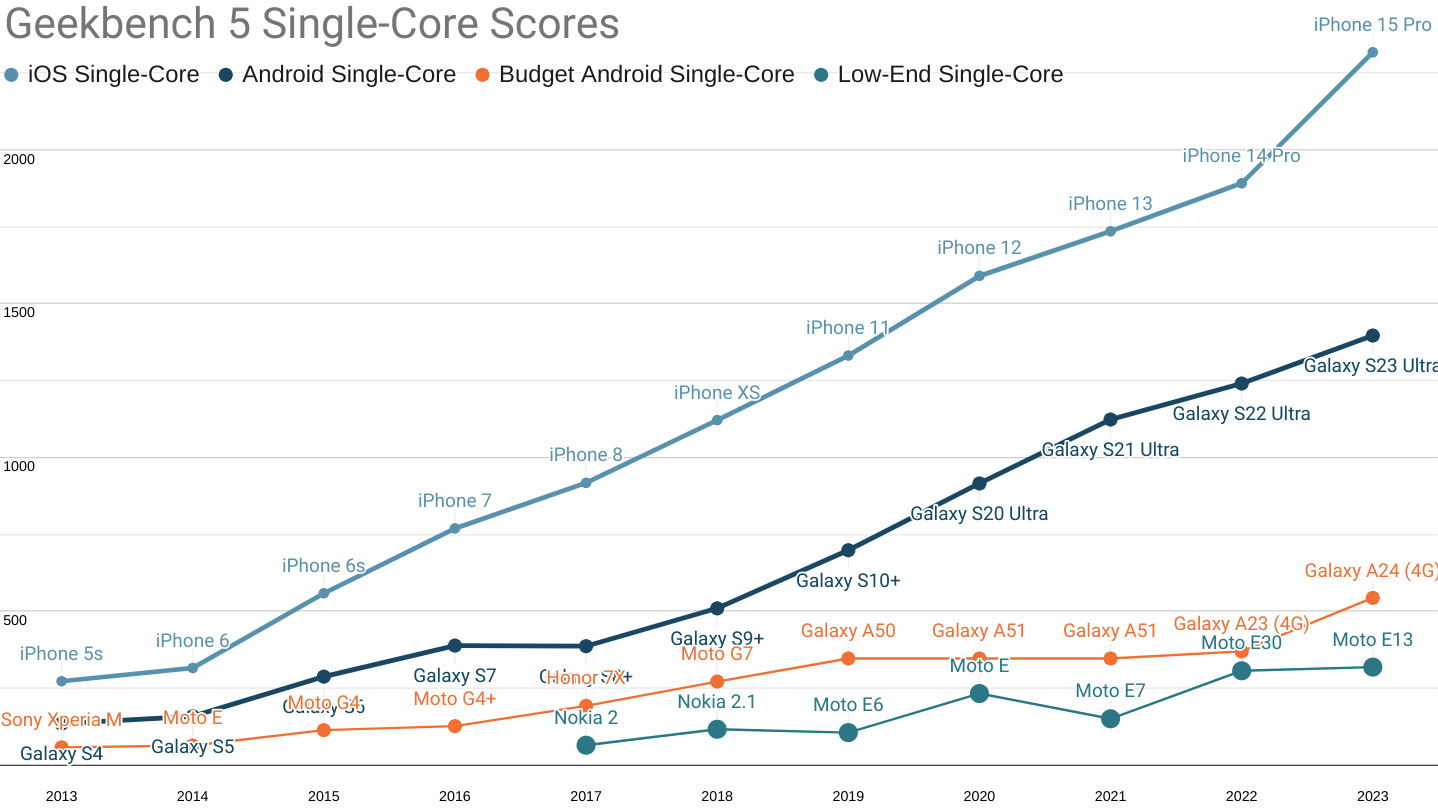
Extending the SoC performance-by-price series with 2023's data, the picture remains ugly:
Tap for a larger version. Geekbench 5 single-core scores for 'fastest iPhone', 'fastest Android', 'budget', and 'low-end' segments.
Not only have fruity phones extended their single-core CPU performance lead over contemporary high-end Androids to a four year advantage, the performance-per-dollar curve remains unfavourable to Android buyers.
At the time of publication, the cheapest iPhone 15 Pro (the only device with the A17 Pro chip) is $999 MSRP, while the S23 (using the Snapdrago 8 gen 2) can be had for $860 from Samsung. This nets out to 2.32 points per dollar for the iPhone, but only 1.6 points per dollar for the S23.
Meanwhile, a $175 (new, unlocked) Samsung A24 scores a more reasonable 3.1 points per dollar on single-core performance, but is more than 4.25× slower than the leading contemporary iPhone.
The delta between the fastest iPhones and moderately price new devices rose from 1,522 points last year to 1,774 today.
Put another way, the performance gap between wealthy users and budget shoppers grew more this year (252 points) than the gains from improved chips delivered at the low end (174 points). Inequality is growing faster than the bottom-end can improve. This is particularly depressing because single-core performance tends to determine the responsiveness of web app workloads.
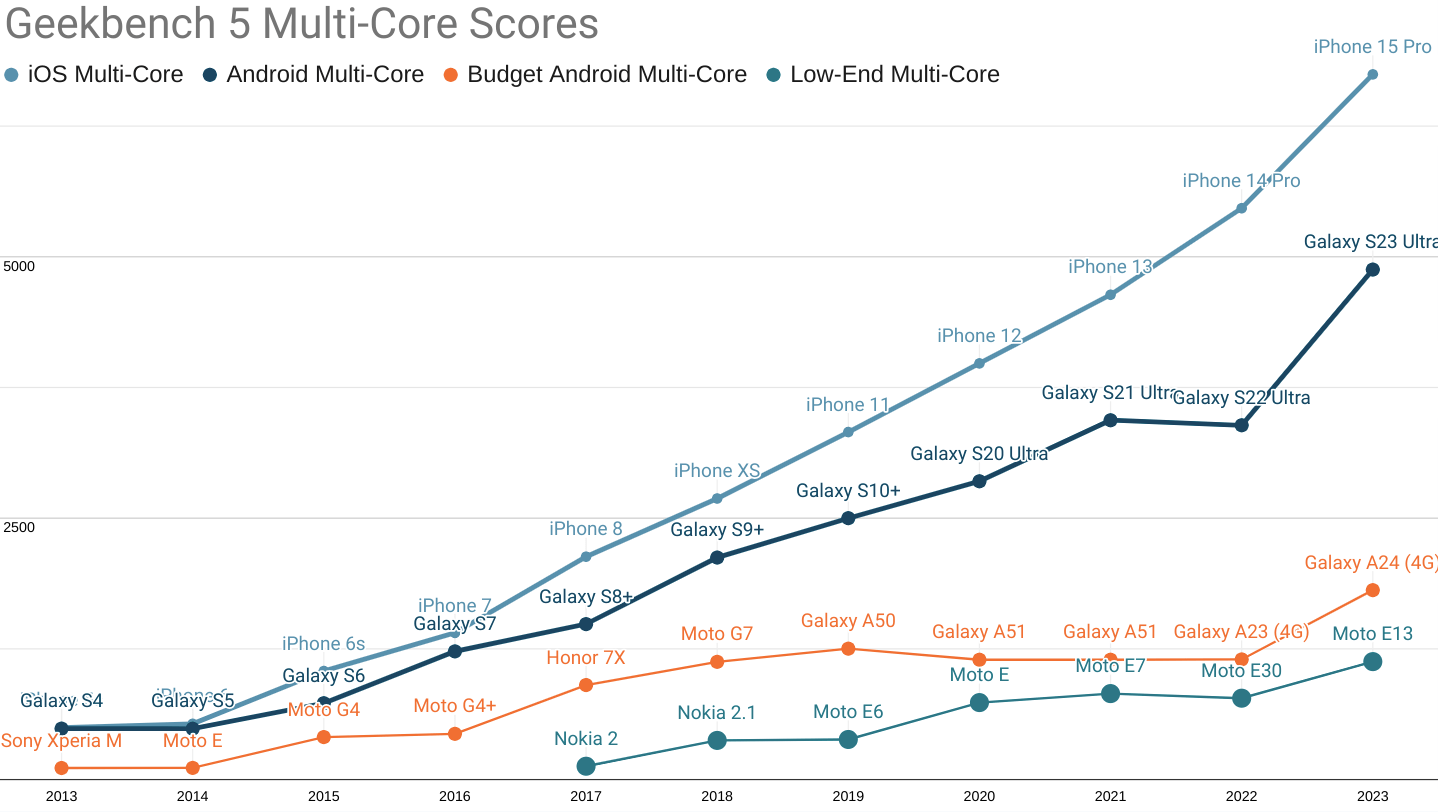
A less pronounced version of the same story continues to play out in multi-core performance:
Tap for a larger version. Round and round we go: Android ecosystem SoCs are improving, but the Performance Inequality Gap continues to grow. Even the fastest Androids are two-plus years behind iOS-ecosystem devices.
Recent advances in high-end Android multi-core performance have closed the previous three-year gap to 18 months. Meanwhile, budget segment devices have finally started to see improvement (as this series predicted), thanks to hand-me-down architecture and process node improvements. That's where the good news ends.
The multi-core performance gap between i-devices and budget Androids grew considerably, with the score delta rising from 4,318 points last year to 4,936 points in 2023.
Looking forward, we can expect high-end Androids to at least stop falling further behind owing to a new focus on performance by Qualcomm's Snapdragon 8 gen 3 and MediaTek's Dimensity 9300 offerings. This change is long, long overdue and will take years to filter down into positive outcomes for the rest of the ecosystem. Until that happens, the gap in experience for the wealthy versus the rest will not close.
iPhone owners experience a different world than high-end Android buyers, and live galaxies apart from the bulk of the market. No matter how you slice it, the performance inequality gap is growing for CPU-bound workloads like JavaScript-heavy web apps.
As ever, 2023 re-confirmed an essential product truth: when experiences are slow, users engage less. Doing a good job in an uneven network environment requires thinking about connection availability and engineering for resilience. It's always better to avoid testing the radio gods than spend weeks or months appeasing them after the damage is done.
5G network deployment continues apace, but as with the arrival of 4G, it is happening unevenly and in ways and places that exacerbate (rather than lessen) performance inequality.[3]
Data on mobile network evolution is sketchy,[4] and the largest error bars in this series' analysis continue to reside in this section. Regardless, we can look industry summaries like the GSMA's report on "The Mobile Economy 2023" (PDF) for a directional understanding that we can triangulate with other data points to develop a strong intuition.
For instance, GSMA predicts that 5G will only comprise half of connections by 2030. Meanwhile, McKinsey predicts that high-quality 5G (networks that use 6GHz bands) will only cover a quarter of the world's population by 2030. Regulatory roadblocks are still being cleared.
This doesn't mean that 4G is one thing, or that it's deployed evenly, or even that the available spectrum will remain stable within a single generation of radio technology. For example, India's network environment has continued to evolve since the Reliance Jio revolution that drove 4G into the mainstream and pushed the price of a mobile megabyte down by ~90% on every subcontinental carrier.
India's speed test medians are moving quickly, but variance is orders-of-magnitude wide, with 5G penetration below 25% in the most populous areas.
These gains are easy to miss looking only at headline "4G vs. 5G" coverage. Improvements arrive unevenly, with the "big" story unfolding slowly. These effects reward us for looking at P75+, not just means or medians, and intentionally updating priors on a regular basis.
Events can turn our intuitions on their heads, too. Japan is famously well connected. I've personally experienced rock-solid 4G through entire Tokyo subway journeys, more than 40m underground and with no hiccups. And yet, the network environment has been largely unchanged by the introduction of 5G. Having provisioned more than adequately in the 4G era, new technology isn't having the same impact from pent-up demand. But despite consistent performance, the quality of service for all users is distributed in a much more egalitarian way:
Japan's network environment isn't the fastest, but is much more evenly distributed.
Fleet device composition has big effects, owing to differences in signal-processing compute availability and spectrum compatibility. At a population level, these influences play out slowly as devices age out, but still have impressively positive impacts:
Device impact on network performance is visible in Opensignal's iPhone dataset.
So, with all of that as prelude, what can we say about where the mobile network baseline should be set? In a departure from years prior, I'm going to use a unified network estimate (see below). You'll have to read on for what it is! But it won't be based on the sort of numbers that folks explicitly running speed tests see; those aren't real life.
The market forces this series previewed in 2017 have played out in roughly a straight line: smartphone penetration in emerging markets is approaching saturation, ensuring a growing fraction of purchases are made by upgrade shoppers. Those who upgrade see more value in their phones and save to buy better second and third devices. Combined with the emergence and growth of the "ultra premium" segment, average selling prices (ASPs) have risen.
2022 and 2023 have established an inflection point in the regard, with worldwide average selling prices jumping to more than $430, up from $300-$350 for much of the decade prior. Some price appreciation has been due to transient impacts of the U.S./China trade wars, but most of it appears driven by iOS ASPs which peaked above $1,000 for the first time in 2023. Android ASPs, meanwhile, continued a gradual rise to nearly $300, up from $250 five years ago.
A weak market for handsets in 2023, plus stable sales for iOS, had an notable impact on prices. IDC expects global average prices to fall back below $400 by 2027 as Android volumes increase from an unusually soft 2023.
Counterpoint data shows declining sales in both 2022 and 2023.Shipment growth in late 2023 and beyond is coming from emerging markets like the Middle East and Africa. Samsung's A-series mid-tier is doing particularly well.
Despite falling sales, distribution of Android versus iOS sales remains largely unchanged:
Android sales reliably constitute 80-85% of worldwide volume.Even in rich nations like Australia and the the U.K., iPhones account for less than half of sales. Predictably, they are over-represented in analytics and logs owing to wealth-related factors including superior network access and performance hysteresis.
Smartphone replacement rates have remained roughly in line with previous years, although we should expect higher device longevity in future years. Survey reports and market analysts continue to estimate average replacement at 3-4 years, depending on segment. Premium devices last longer, and a higher fraction of devices may be older in wealthy geographies. Combined with discretionary spending pressure and inflationary impacts on household budgets, consumer intent to spend on electronics has taken a hit, which will be felt in device lifetime extension until conditions improve. Increasing demand for refurbished devices also adds to observable device aging.
The data paints a substantially similar picture to previous years: the web is experienced on devices that are slower and older than those carried by affluent developers and corporate directors whose purchasing decisions are not impacted by transitory inflation.
Re-using last year's P75 device calculus, our estimate is based on a device sold new, unlocked for the mid-2020 to mid-2021 global ASP of ~$350-375.
Representative examples from that time period include the Samsung Galaxy A51 and the Pixel 4a. Neither model featured 5G,[5] and we cannot expect 5G to play a significant role in worldwide baselines for at least the next several years.[3:1]
Google spent more on the SoC for the Pixel 4a and enjoyed a later launch date, boosting performance relative to the A51.
Pixels have never sold well, and Google's focus on strong SoC performance per dollar was sadly not replicated across the Android ecosystem, forcing us to use the A51 as our stand-in.
Devices within the envelope of our attention are 15-25% as fast as those carried by programmers and their bosses — even in wealthy markets.
Geekbench 5 shows almost no improvement between the A50 and the A51.Geekbench 6 shows the same story within the margin of error. The low-end is stagnant, and still 30% of worldwide volume.
If you're building a test lab today, refurbished A51s can be had for ~$150. Even better, the newer Nokia G100 can be had for as little as $100, and it's faithful to the sluggish original in nearly every respect.[6]
If your test bench is based on last year's recommended A50 or Nokia G11, I do not recommend upgrading in 2024. The absolute gains are so slight that the difference will be hard to feel, and bench stability has a value all its own. Looking forward, we can also predict that our bench performance will be stable until 2025.
Claims about how "performant" modern frontend tools are have to be evaluated in this slow, stagnant context.
It's a bit easier to understand the Desktop situation because the Edge telemetry I have access to provides statistically significant insight into 85+% of the market.
The TL;DR for desktop performance is that Edge telemetry puts ~45% of devices in a "low-end" bucket, meaning they have <= 4 cores or <= 4GB of RAM.
Device Tier
Fleet %
Definition
Low-end
45%
Either: <= 4 cores, or <= 4GB RAM
Medium
48%
HDD (not SSD), or 4-16 GB RAM, or 4-8 cores
High
7%
SSD + > 8 cores + > 16GB RAM
20% of users are on HDDs (not SSDs) and nearly all of those users also have low (and slow) cores.
You might be tempted to dismiss this data because it doesn't include Macs, which are faster than the PC cohort. Recall, however, that the snapshot also excludes ChromeOS.
ChromeOS share has veered wildly in recent years, representing 50%-200% of Mac shipments in a given per quarter. In '21 and '22, ChromeOS shipments regularly doubled Mac sales. Despite post-pandemic mean reversion, according to IDC ChromeOS devices outsold Macs ~5.7M to ~4.7M in 2023 Q2. The trend reversed in Q3, with Macs almost doubling ChromeOS sales, but slow ChromeOS devices aren't going away and, from a population perspective, more than offset Macs today. Analysts also predict growth in the low end of the market as educational institutions begin to refresh their past purchases.
This suggests that it's time to also bump our baseline for desktop tests beyond the 5Mbps/1Mbps/28ms configuration that WebPageTest.org's "Cable" profile has defaulted to for desktop tests.
How far should we bump it? Publicly available data is unclear, and I've come to find out that Edge's telemetry lacks good network observation statistics (doh!).
But the comedy of omissions doesn't end there: Windows telemetry doesn't capture a proxy for network quality, I no longer have access to Chrome's data, the population-level telemetry available from CrUX is unhelpful, and telcos li...er...sorry, "market their products in accordance with local laws and advertising standards."
All of this makes it difficult to construct an estimate.
One option is to use a population-level assessment of medians from something like the Speedtest.net data and then construct a histogram from median speeds. This is both time-consuming and error-prone, as population-level data varies widely across the world. Emerging markets with high mobile internet use and dense populations can feature poor fixed-line broadband penetration compared with Western markets.
Another option is to mathematically hand-wave using the best evidence we can get. This might allow us to reconstruct probable P75 and P90 values if we know something about the historical distribution of connections. From there, we can gut-check using other spot data. To do this, we need to assume some data set is representative, a fraught decision all its own.[7] Biting the bullet, we could start from the Speedtest.net global survey data, which currently fails to provide anything but medians (P50):
Speedtest.net's global median values are unhelpful on their own, both because they represent users who are testing for speed (and not organic throughput) and because they don't give us a fuller understanding of the distribution.
After many attempted Stupid Math Tricks with poorly fitting curves (bandwidth seems to be a funky cousin of log-normal), I've decided to wing it and beg for help: instead of trying to be clever, I'm leaning on Cloudflare Radar's P25/P50/P75 distributions for populous, openly-connected countries with >= ~50M internet users. It's cheeky, but a weighted average of the P75 of download speeds (3/4ths of all connections are faster) should get us in the ballpark. We can then use the usual 5:1 downlink:uplink ratio to come up with an uplink estimate. We can also derive a weighted average for the P75 RTT from Cloudflare's data. Because Cloudflare doesn't distinguish mobile from desktop connections, this may be an overly conservative estimate, but it's still be more permissive than what we had been pegged to in years past:
National P75 Downlink and RTT
Country
P75 Downlink (Mbps)
P75 RTT (ms)
India
4
114
USA
11
58
Indonesia
5
81
Brazil
8
71
Nigeria
3
201
Pakistan
3
166
Bangladesh
5
114
Japan
17
42
Mexico
7
75
Egypt
4
100
Germany
16
36
Turkey
7
74
Philippines
7
72
Vietnam
7
72
United Kingdom
16
37
South Korea
24
26
Population Weighted Avg.
7.2
94
We, therefore, update our P75 link estimate 7.2Mbps down, 1.4Mbps up, and 94ms RTT.
This is a mild crime against statistics, not least of all because it averages unlike quantities and fails to sift mobile from desktop, but all the other methods available at time of writing are just as bad. Regardless, this new baseline is half again as much link capacity as last year, showing measurable improvement in networks worldwide.
If you or your company are able to generate a credible worldwide latency estimate in the higher percentiles for next year's update, please get in touch.
The forces that shape the PC population have been largely fixed for many years. Since 2010, volumes have been on a slow downward glide path, shrinking from ~350MM per year in a decade ago to ~260MM in 2018. The pandemic buying spree of 2021 pushed volumes above 300MM per year for the first time in eight years, with the vast majority of those devices being sold at low-end price points — think ~$300 Chromebooks rather than M1 MacBooks.
Lest we assume low-end means "short-lived", recent announcements regarding software support for these devices will considerably extend their impact. This low-end cohort will filter through the device population for years to come, pulling our performance budgets down, even as renewed process improvement is unlocking improved power efficiency and performance at the high end of the first-sale market. This won't be as pronounced as the diffusion of $100 smartphones has been in emerging markets, but the longer life-span of desktops is already a factor in our model.
Per our methodology from last year which uses the 5-8 year replacement cycle for a PC, we update our target date to late 2017 or early 2018, but leave the average-selling-price fixed between $600-700. Eventually we'll need to factor in the past couple of years of gyrations in inflation and supply chains into account when making an estimate, but not this year.
So what did $650, give or take, buy in late 2017 or early 2018?
What does this mean for our target devices? There's wild variation in performance per dollar below $600 which will only increase as inflation-affected cohorts grow to represent a larger fraction of the fleet. Intel's move off of 14nm (finally!) also means that gains are starting to arrive at the low end, but in an uneven way. General advice is therefore hard to issue. That said, we can triangulate based on what we know about the market:
There's a lot of good news embedded in this year's update. Devices and networks have finally started to get faster (as predicted), pulling budgets upwards.
We can anticipate continued improvement in devices, while network gains will level out as the uneven deployment of 5G stumbles forward. Regardless, the gap between the digital haves and have-nots continues to grow. Those least able to afford fast devices are suffering regressive taxation from developers high on DX fumes.
It's no mystery why folks in the privilege bubble are not building with empathy or humility when nobody calls them to account. What's mysterious is that anybody pays them to do it.
The PM and EM disciplines have utterly failed, neglecting to put business constraints on the enthusiasms of developers. This burden is falling, instead, on users and their browsers. Browsers have had to step in as the experience guardians of last resort, indicating a market-wide botching of the job in technology management ranks and an industry-scale principal-agent issue amongst developers.
Instead of cabining the FP crowd's proclivities for the benefit of the business, managers meekly repeat bullshit like "you can't hire for fundamentals" while bussing in loads of React bootcampers. It is not too much to ask that managers run bake-offs and hire for skills in platform fundamentals that serve businesses better over time. The alternative is continued failure, even for fellow privilege bubble dwellers.
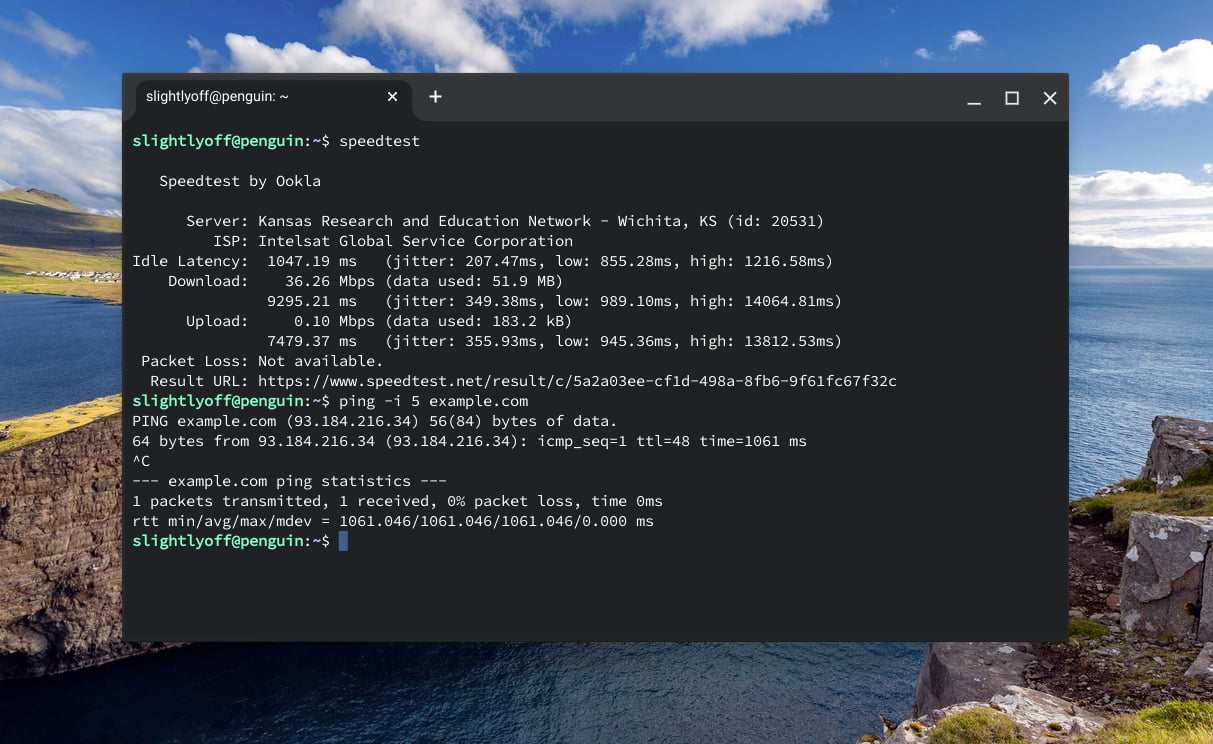
Case in point: this post was partially drafted on airplane wifi, and I can assure you that wealthy folks also experience RTT's north of 500ms and channel capacity in the single-digit-Mbps.
Even the wealthiest users step into the wider world sometimes. Are these EMs and PMs really happy to lose that business?
Tap for a larger version. Wealthy users are going to experience networks with properties that are even worse than the 'bad' networks offered to the Next Billion Users. At an altitude of 40k feet and a ground speed for 580 MPH somewhere over Alberta, CA, your correspondent's bandwidth is scarce, lopsided, and laggy.
Of course, any trend that can't continue won't, and INP's impact is already being felt. The great JavaScript merry-go-round may grind to a stop, but the momentum of consistently bad choices is formidable. Like passengers on a cruise ship ramming a boardwalk at flank speed, JavaScript regret is dawning far too late. As the good ship Scripting shudders and lists on the remains of the ferris wheel, it's not exactly clear how to get off, but the choices that led us here are becoming visible, if only through their negative consequences.
We got to a place where performance has been a constant problem in large part because a tribe of programmers convinced themselves that it wasn't and wouldn't be. The circa '13 narrative asserted that:
CPUs would keep getting faster (just like they always had).
Networks would get better, or at least not get worse.
Organisations had all learned the lessons of Google and Facebook's adventures in Ajax.
It was all bullshit, and many of us spotted it a mile away.
The problem is now visible and demands a solution, but the answers will be largely social, not technical. User-centered values must contest the airtime previouly taken by failed trickle-down DX mantras. Only when the dominant story changes will better architectures and tools win.
How deep was the branch? And how many cycles will the fault cost us? If CPUs and networks continue to improve at the rate of the past two years, and INP finally forces a reckoning, the answer might be as little as a decade. I fear we will not be so lucky; an entire generation has been trained to ignore reality, to prize tribalism rather than engineering rigor, and to devalue fundamentals. Those folks may not find the next couple of years to their liking.
Frontend's hangover from the JavaScript party is gonna suck.
The five second first-load target is arbitrary, and has always been higher than I would prefer. Five seconds on a modern computer is an eternity, but in 2016 I was talked down from my preferred three-second target by Googlers that despaired that "nobody" could hit that mark on the devices and networks of that era.
This series continues to report budgets with that target, but keen readers will see that I'm also providing three-second numbers. The interactive estimation tool was also updated this year to provides the ability to configure the budget target.
If you've got thoughts about how this should be set in future, or how it could be handled better, plesae get in touch.↩︎↩︎
Frontend developers are cursed to program The Devil's Computer. Web apps execute on slow devices we don't spec or provision, on runtimes we can barely reason about, lashed to disks and OSes taxed by malware and equally invasive security software, over networks with the variability of carrier pigeons.
It's vexing, then, that contemporary web development practice has decided that the way to deliver great experiences is to lean into client CPUs and mobile networks, the most unreliable, unscalable properties of any stack.
For at least a decade to come, 5G will continue to deliver unevenly depending on factors including building materials, tower buildout, supported frequencies, device density, radio processing power, and weather. Yes, weather (PDF).
Even with all of those caveats, 5G networks aren't the limiting factor in wealthy geographies; devices are. It will take years for the deployed base to be fully replaced with 5G-capable handsets, and we should expect the diffusion to be "lumpy", with wealthy markets seeing 5G device saturation at nearly all price points well in advance of less affluent countries where capital availability for 5G network roll-outs will dominate.↩︎↩︎
Ookla! Opensignal! Cloudflare! Akamai! I beseech thee, hear my plea and take pity, oh mighty data collectors.
Whilst you report medians and averages (sometimes interchangeably, though I cannot speculate why), you've stopped publishing useable histogram information about the global situation, making the reports nearly useless for anything but telco marketing. Opensignal has stopped reporting meaningful 4G data at all, endangering any attempt at making sense.
Please, I beg of you, publish P50, P75, P90, and P95 results for each of your market reports! And about the global situation! Or reach out directly and share what you can in confidence so I can generate better guidance for web developers. ↩︎
Both the benchmark A51 and Pixel 4a devices were eventually sold in 5G variants (A51 5G, Pixel 4a 5G), but at a price of $500 brand-new, unlocked at launch, making them more than 40% above the price of the base models and well above our 2020-2021 ASP of $350-$375. ↩︎
Samsung's lineup is not uniform worldwide, with many devices being region-specific. The closest modern (Western) Samsung device to the A51 is the Samsung A23 5G, which scores in the range of the Pixel 4a. As a result of the high CPU score and 5G modem, it's hard to recommend it — or any other current Samsung model — as a lab replacement. Try the Nokia G100 instead.↩︎
The idea that any of the publicly available data sets is globally representative should set off alarms.
The obvious problems include (but are not limited to):
geographic differences in service availability and/or deployed infrastructure,
differences in market penetration of observation platforms (e.g., was a system properly localised? Equally advertised?), and
mandated legal gaps in coverage.
Of all the hand-waving we're doing to construct an estimate, this is the biggest leap and one of the hardest to triangulate against. ↩︎
]]>Why Are Tech Reporters Sleeping On The Biggest App Store Story?2024-01-01T00:00:00Zhttps://infrequently.org/2024/01/the-web-is-the-app-store/The tech news is chockablock[1] with antitrust rumblings and slow-motion happenings. Eagle-eyed press coverage, regulatory reports, and legal discovery have comprehensively documented the shady dealings of Apple and Google's app stores. Pressure for change has built to an unsustainable level. Something's gotta give.
This is the backdrop to the biggest app store story nobody is writing about: on pain of steep fines, gatekeepers are opening up to competing browsers. This, in turn, will enable competitors to replace app stores with directories of Progressive Web Apps. Capable browsers that expose web app installation and powerful features to developers can kickstart app portability, breaking open the mobile duopoly.
But you'd never know it reading Wired or The Verge.
With shockingly few exceptions, coverage of app store regulation assumes the answer to crummy, extractive native app stores is other native app stores. This unexamined framing shapes hundreds of pieces covering regulatory events, including by web-friendly authors. The tech press almost universally fails to mention the web as a substitute for native apps and fail to inform readers of its potential to disrupt app stores.
"An app is just a web-page wrapped in enough IP to make it a crime to defend yourself against corporate predation."
The implication is clear: browsers unchained can do to mobile what the web did to desktop, where more than 70% of daily "jobs to be done" happen on the web.
Replacing mobile app stores will look different than the web's path to desktop centrality, but the enablers are waiting in the wings. It has gone largely unreported that Progressive Web Apps (PWAs) have been held back by Apple and Google denying competing browsers access to essential APIs.[2]
Thankfully, regulators haven't been waiting on the press to explain the situation. Recent interventions into mobile ecosystems include requirements to repair browser choice, and the analysis backing those regulations takes into account the web's role as a potential competitor (e.g., Japan's JFTC (pdf)).
Regulators seem to understand that:
App stores protect proprietary ecosystems through preferential discovery and capabilities.
Stores then extract rents from developers dependent on commodity capabilities duopolists provide only through proprietary APIs.
App portability threatens the proprietary agenda of app stores.
The web can interrupt this model by bringing portability to apps and over-the-top discovery through search. This has yet to happen because...
The duopolists, in different ways, have kneecapped competing browsers along with their own, keeping the web from contesting the role of app stores.
Apple and Google saw what the web did to desktop, and they've laid roadblocks to the competitive forces that would let history repeat on smartphones.
None of the linked articles note browser competition's potential to upend app stores. Browsers unshackled have the potential to free businesses from build-it-twice proprietary ecosystems, end rapacious app store taxes, pave the way for new OS entrants — all without the valid security concerns side-loading introduces.
Reporters are "covering" these stories in the lightest sense of the word. Barrels of virtual ink has been spilt documenting unfair app store terms, conditions, and competition. And yet.
Next, it's hard to overlook that tech reporters live like wealthy people, iPhones and all. From that vantage point, it's often news that the web is significantly more capable on other OSes (never mind that they spend much of every day working in a desktop browser). It's hard to report on the potential of something you can't see for yourself.
Also, this might all be Greek. Reporters and editors aren't software engineers, so the potential of browser competition can remain understandably opaque. Stories that include mention of "alternative app stores" generally fail to mention that these stores may not be as safe, or that OS restrictions on features won't disappear just because of a different distribution mechanism, or that the security track records of the existing duopolist app stores are sketchy at best. Under these conditions, it's asking a lot to expect details-based discussion of alternatives, given the many technical wrinkles. Hopefully, someone can walk them through it.
Further, market contestability theory has only recently become a big part of the tech news beat. Regulators have been writing reports to convey their understanding of the market, and to shape effective legislation that will unchain the web, but smart folks unversed in both antitrust and browser minutiae might need help to pick up what regulators are putting down.
Lastly, it hasn't happened yet. Yes, Progressive Web Apps have been around for a few years, but they haven't had an impact on the iPhones that reporters and their circles almost universally carry. It's much easier to get folks to cover stories that directly affect them, and this is one that, so far, largely hasn't.
As an example, the eight-year delay in implementing Push Notifications for the web[3] kept many businesses from giving the web a second thought. If they couldn't re-engage users at the same rates as native apps, the web might as well not exist on phones. This logic has played out on a loop over the last decade, category-by-category, with gatekeepers preventing competing browsers from bringing capabilities to web apps that would let them supplant app stores[2:1] while simultaneously keeping them from being discovered through existing stores.
Proper browser choice could upend this situation, finally allowing the web to provide "table stakes" features in a compelling way. For the first time, developers could bring the modern web's full power to wealthy mobile users, enabling the "write once, test everywhere" vision, and cut out the app store middleman — all without sacrificing essential app features or undermining security.
Sunsetting the 30% tax requires a compelling alternative, and Apple's simultaneous underfunding of Safari and compelled adoption of its underpowered engine have interlocked to keep the web out of the game. No wonder Apple is massively funding lobbyists, lawyers, and astroturf groups to keep engine diversity at bay while belatedly battening the hatches.
On the business side, managers think about "mobile" as a category. Rather than digging into the texture of iOS, Android, and the differing web features available on each, businesses tend to bulk accept or reject the app store model. One sub-segment of "mobile" growing the ability to route around highway robbery Ts & Cs is tantalising, but not enough to change the game; the web, like other metaplatforms, is only a disruptive force when pervasive and capable.[4]
A prohibition on store discovery for web apps has buttressed Apple's denial of essential features to browsers:
Even if developers overcome the ridiculous hurdles that Apple's shoddy browser engine throws up, they're still prevented by Apple policy from making interoperable web apps discoverable where users look for them.
Recent developments also point to a competitive future for capable web apps.
First, browser engine choice should become a reality on iOS in the EU in 2024, thanks to the plain language of the DMA. Apple will, of course, attempt to delay the entry of competing browsers through as-yet-unknown strategies, but the clock is ticking. Once browsers can enable capable web apps with easier distribution, the logic of the app store loses a bit of its lustre.
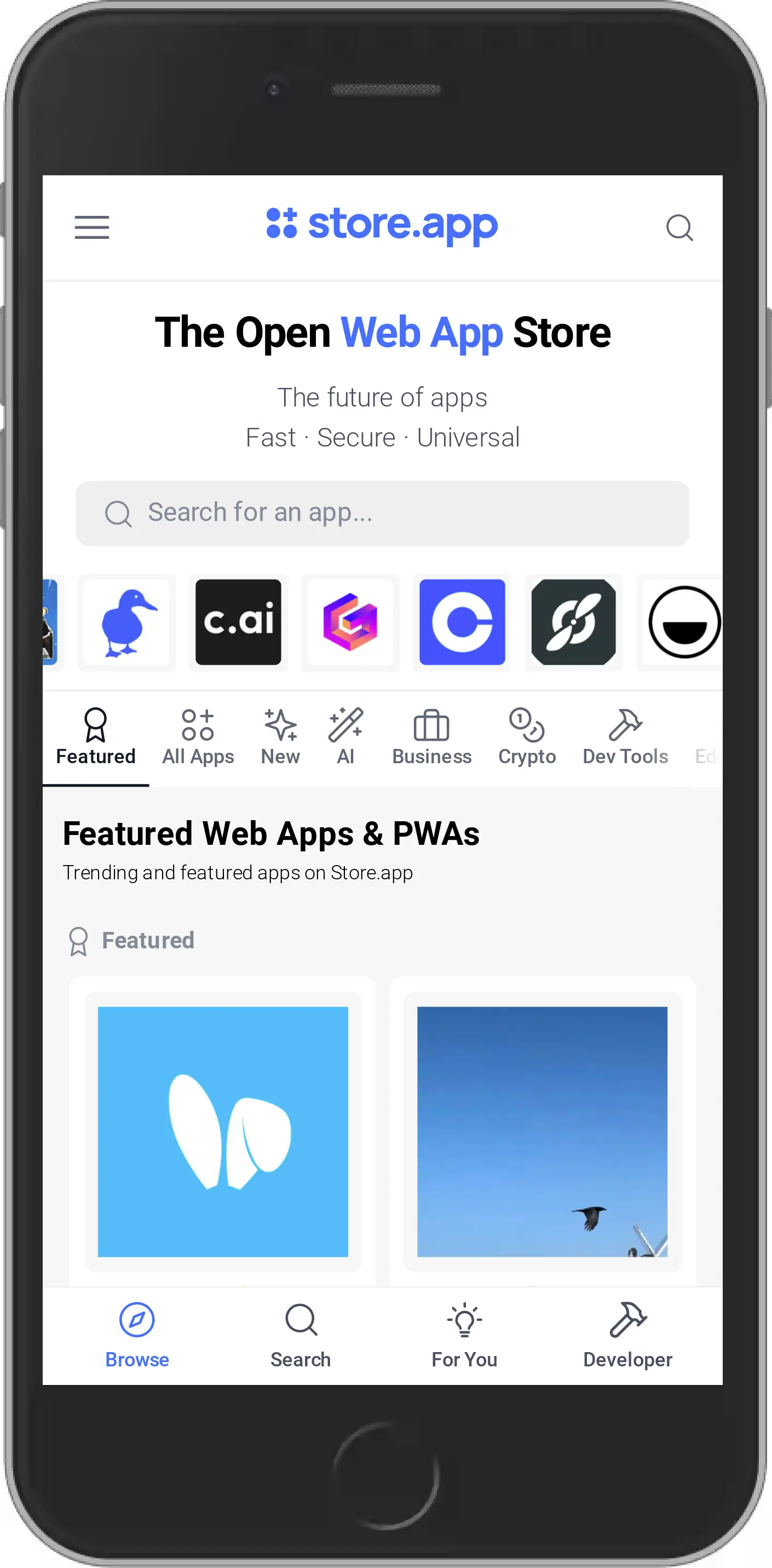
Work is also underway to give competing browsers a chance to facilitate PWAs that can install other PWAs. Web App Stores would then become a real possibility through browsers that support them, and we should expect that regulatory and legislative interventions will facilitate this in the near future. Removed from the need to police security (browsers have that covered) and handle distribution (websites update themselves), PWA app stores like store.app can become honest-to-goodness app management surfaces that can safely facilitate discovery and sync.
PWA app stores like Appscope and store.app exist, but they're hobbled by gatekeepers that have denied competing browsers access to APIs that could turn PWA directories into real contenders.
It's no surprise that Apple and Google have kept private the APIs needed to make this better future possible. They built the necessary infrastructure for the web to disrupt native, then kept it to themselves. This potential has remained locked away within organisations politically hamstrung by native app store agendas. But all of that is about to change.
This begs the question: where's the coverage? This is the most exciting moment in more than 15 years for the web vs. native story, but the tech press is whiffing it.
2024 will be packed to the gills with app store and browser news, from implementation of the DMA, to the UK's renewed push into mobile browsers and cloud gaming, to new legislation arriving in many jurisdictions, to the first attempts at shipping iOS ports of Blink and Gecko browsers. Each event is a chance to inform the public about the already-raging battle for the future of the phone.
It's still possible to reframe these events and provide better context. We need a fuller discussion about what it will mean for mobile OSes to have competing native app stores when the underlying OSes are foundationally insecure. There are also existing examples of ecosystems with this sort of choice (e.g., China), and more needs to be written about the implications for users and developers. Instead of nirvana, the insecure status quo of today's mobile OSes, combined with (even more) absentee app store purveyors, turns side-loading into an alternative form of lock-in, with a kicker of added insecurity for users. With such a foundation, the tech-buying public could understand why a browser's superior sandboxing, web search's better discovery, and frictionless links are better than dodgy curation side-deals and "beware of dog" sign security.
The more that folks understand the stakes, the more likely tech will genuinely change for the better. And isn't that what public interest journalism is for?
Antitrust is now a significant tech beat, and recent events frequently include browser choice angles because regulators keep writing regulations that will enhance it. This beat is only getting more intense, giving the tech press ample column inches to explain the status quo more deeply and and educate around the most important issues.
Google's witness also blurted out a statistic that is both anodyne and damning: 36%. That's what Google pays Apple in search rev-share for default search placement in Safari. Normally, this would be a detail of a boring business deal. In context, however, it highlights Apple's decade-long suppression of iOS browser competition — combined with poverty-level funding of WebKit — which has skimmed tens of billions in profit per year from the web while starving browser development. This has deprived users, businesses, and web developers of safe (but critical) capabilities. It wasn't just Play that buggered the mobile web; Google was happy to outsource the dirty deed too.
Perhaps Apple didn't appeal because, in November, the UK unexpectedly brought forward the Digital Markets, Competition and Consumers Bill. It looks set to become law early in the new year, standing up a regulator with real teeth who, one presumes, will not be predisposed to think well of Apple's delay of its predecessor's investigations.
On the other side of the planet, news just broke that Japan will bring forward legislation to target app store shenanigans. Given the JFTC's earlier findings about how interlocking layers of control have kept browsers from contesting app store prominence, we can expect some spicy legislative language around browsers.
Australia has also just agreed (in principle) to do the same, including language that acknowledges the role suppressing browser choice has had in preventing the web from competing with mobile native app ecosystems.
All but one of the 19 links above are from just the last 60 days, a period which includes a holiday break in the US and Europe. With the EU's DMA coming into force in March and the CMA back on the job, browser antitrust enforcement is only accelerating. It sure would be great if reporters could occasionally connect these dots. ↩︎
The stories of how Apple and Google have kept browsers from becoming real app stores differ greatly in their details, but the effects have been nearly identical: only their browsers could offer installation of web apps, and those browsers have done shockingly little to support web developers who want to depend on the browser as the platform.
The ways that Apple has undermined browser-based stores is relatively well known: no equivalent to PWA install or "Smart Banners" for the web, no way for sites to suppress promotion of native apps, no ability for competing browsers to trigger homescreen installation until just this year, etc. etc. The decade-long build of Apple's many and varied attacks on the web as a platform is a story that's both tired and under-told.
Google's malfeasance has gotten substantially less airtime, even among web developers – nevermind the tech press.
The story picks up in 2017, two years after the release of PWAs and Push Notifications in Chrome. At the time, the PWA install flow was something of a poorly practised parlour trick: installation used an unreliable homescreen shortcut API that failed on many devices with OEM-customised launchers. The shortcut API also came laden with baggage that prevented effective uninstall and cross-device sync.
To improve this situation, "WebAPKs" were developed. This new method of installation allows for deep integration with the OS, similar to the Application Identity Proxy feature that Windows lets browsers to provide for PWAs, with one notable exception: on Android, only Chrome gets to use the WebAPK system.
Without getting into the weeds, suffice to say many non-Chrome browsers requested access. Only Google could meaningfully provide this essential capability across the Android ecosystem. So important were WebAPKs that Samsung gave up begging and reverse engineered it for their browser on Samsung devices. This only worked on Samsung phones where Suwon's engineers could count on device services and system keys not available elsewhere. That hasn't helped other browsers, and it certainly isn't an answer to an ecosystem-level challenge.
Without WebAPK API access, competing browsers can't innovate on PWA install UI and can't meaningfully offer PWA app stores. Instead, the ecosystem has been left to limp along at the excruciating pace of Chrome's PWA UI development.
Sure, Chrome's PWA support has been a damn sight better than Safari's, but that's just damning with faith praise. Both Apple and Google have done their part to quietly engineer a decade of unchallenged native app dominance. Neither can be trusted as exclusive stewards of web competitiveness. Breaking the lock on the doors holding back real PWA installation competition will be a litmus test for the effectiveness of regulation now in-flight. ↩︎↩︎
Push Notifications were, without exaggeration, the single most requested mobile Safari feature in the eight years between Chromium browsers shipping and Apple's 2023 capitulation.
It's unedifying to recount all of the ways Apple prevented competing iOS browsers from implementing Push while publicly gaslighting developers who requested this business-critical feature. Over and over and over again. It's also unhelpful to fixate on the runarounds that Apple privately gave companies with enough clout to somehow find an Apple rep to harangue directly. So, let's call it water under the bridge. Apple shipped, so we're good, right?
Right?
I regret to inform you, dear reader, that it is not, in fact, "good".
Despite most of a decade to study up on the problem space, and nearly 15 years of of experience with Push, Apple's implementation is anything but complete.
The first few releases exposed APIs that hinted at important functionality that was broken or missing. Features as core as closing notifications, or updating text when new data comes in. The implementation of Push that Apple shipped could not allow a chat app to show only the latest message, or a summary. Instead, Apple's broken system leaves a stream of notifications in the tray for every message.
Many important features didn't work. Some still don't.. And the pathetic set of customisations provided for notifications are a sick, sad joke.
Web developers have once again been left to dig through the wreckage to understand just how badly Apple's cough "minimalist" cough implementation is compromised. And boy howdy, is it bad.
Apple's implementation might have passed surface-level tests (gotta drive up that score!), but it's unusable for serious products. It's possible to draw many possible conclusions from this terrible showing, but even the relative charity of Hanlon's Razor is damning.
Nothing about this would be worse than any other under-funded, trailing-edge browser over the past three decades (which is to say, a bloody huge problem), except for Apple's well-funded, aggressive, belligerent ongoing protest to every regulatory attempt to allow true browser choice for iPhone owners.
In the year 2024, you can have any iOS browser you like. You can even set them as default. They might even have APIs that look like they'll solve important product needs, but as long as they're forced to rely on Apple's shit-show implementation, the web can't ever be a competitive platform.
When Apple gets to define the web's potential, the winner will always be native, and through it, Apple's bottom line. ↩︎
The muting effect of Apple's abuse of monopoly over wealthy users to kneecap the web's capabilities is aided by the self-censorship of web developers. The values of the web are a mirror world to native, where developers are feted for adopting bleeding-edge APIs. On the web, features aren't "available" until 90+% of all users have access to them. Because iOS is at least 20% of the pie), web developers don't go near features Apple fails to support. Which is a lot.
caniuse.com's "Browser Score" is one way to understand the scale of the gap in features that Apple has forced on all iOS browsers.
The Web Platform Tests dashboard highlights 'Browser Specific Failures', which only measure failures in tests for features the browser claims to support. Not only are iOS browsers held back by Apple's shockingly poor feature support, but the features that _are_ available are broken so often that many businesses feel no option but to retreat to native APIs that Apple doesn't break on a whim, forcing the logic of the app store on them if they want to reach valuable users.
Apple's pocket veto over the web is no accident, and its abuse of that power is no bug.
Native app stores can only take an outsized cut if the web remains weak and developers stay dependent on proprietary APIs to access commodity capabilities. A prohibition on capable engines prevents feature parity, suppressing competition. A feature-poor, unreliable open web is essential to prevent the dam from breaking.
Why, then, have competing browser makers played along? Why aren't Google, Mozilla, Microsoft, and Opera on the ramparts, waving the flag of engine choice? Why do they silently lend their brands to Apple's campaign against the web? Why don't they rename their iOS browsers to "Chrome Lite" or "Firefox Lite" until genuine choice is possible? Why don't they ask users to write their representatives or sign petitions for effective browser choice? It's not like they shrink from it for other worthy causes.
I'm shocked by not surprised by the tardiness of browser bosses to seize the initiative. Instead of standing up to unfair terms, they've rolled over time and time again. It makes a perverse sort of sense.
More than 30 years have passed since we last saw effective tech regulation. The careers of those at the top have been forged under the unforgiving terms of late-stage, might-makes-right capitalism, rather than the logic of open markets and standards. Today's bosses didn't rise by sticking their necks above the parapets to argue virtue and principle. At best, they kept the open web dream alive by quietly nurturing the potential of open technology, hoping the situation would change.
Now it has, and yet they cower.
Organisations that value conflict aversion and "the web's lane is desktop" thinking get as much of it as they care to afford. ↩︎
Recall that Apple won an upset victory in March after litigating the meaning of the word "may" and arguing that the CMA wasn't wrong to find after multiple years of investigations that Apple were (to paraphrase) inveterate shitheels, but rather that the CMA waited too long (six months) to bring an action which might have had teeth.
Yes, you're reading that right; Apple's actual argument to the Competition Appeal Tribunal amounted to a mashup of rugged, free-market fundamentalist " but mah regulatory certainty!", performative fainting into strategically placed couches, and feigned ignorance about issues it knows it'll have to address in other jurisdictions.
Thankfully, the Court of Appeals was not to be taken for fools. Given the harsh (in British) language of the reversal, we can hope a chastened Competition Appeal Tribunal will roll over less readily in future. ↩︎
Claims competitors that it has expressly ham-strung are credible substitutes. When that fails...
Claims security would suffer if reasonable competition were allowed. Rending of garments is performed while prophets of doom recycle the script that the sky will fall if competing browsers are allowed (which would, in turn, expand the web's capabilities). Many treatments of this script fill the inboxes of regulators worldwide. When those bodies investigate, e.g. the history of iOS's forced-web-monoculture insecurity, and inevitably reject these farcical arguments, Apple...
Uses any and every procedural hurdle to prevent intervention in the market it has broken.
The modern administrative state indulges firms with "as much due process as money can buy", and Apple knows it, viciously contesting microscopic points. When bluster fails, huffingly implemented, legalistic, hair-splitting "fixes" are deployed on the slowest possible time scale. This strategy buys years of delay, and it's everywhere: browser and mail app defaults, payment alternatives, engine choice, and right-to-repair. Even charging cable standardisation took years longer than it should have thanks to stall tactics. This maximalist, joined-up legal and lobbying strategy works to exhaust regulators and bamboozle legislators. Delay favours the monopolist.
A firm that can transform the economy of an entire nation just by paying a bit of the tax it owes won't even notice a line item for lawyers to argue the most outlandish things at every opportunity. Apple (correctly) calculates that regulators are gun-shy about punishing them for delay tactics, so engagement with process is a is a win by default. Compelling $1600/hr white-shoe associates to make ludicrous, unsupportable claims is a de facto win when delay brings in billions. Regulators are too politically cowed and legally ham-strung to do more, and Apple plays process like a fiddle. ↩︎
]]>Safari 16.4 Is An Admission2023-02-22T00:00:00Zhttps://infrequently.org/2023/02/safari-16-4-is-an-admission/If you're a web developer not living under a rock, you probably saw last week's big Safari 16.4 reveal. There's much to cheer, but we need to talk about why this mega-release is happening now, and what it means for the future.
Apple's summary combines dozens of minor fixes with several big-ticket items. Here's an overview of the most notable features, prefixed with the year they shipped in Chromium:
Myriad small CSS improvements and animation fixes, but also:
: CSS Typed OM for faster styling from JavaScript
: CSS Custom Properties can now be animated
: <iframe> lazy loading
: Clear-Site-Data for Service Worker use at scale
: Web Codecs for video (but not audio)
: WASM SIMD for better ML and games
: Compression Streams
: Reporting API (for learning about crashes and metrics reporting)
: Screen Orientation & Screen Wake Lock APIs (critical for games)
: Offscreen Canvas (but only 2D, which isn't what folks really need)
Critical usability and quality fixes for WebRTC
A number of improvements look promising, but remain exclusive to macOS and iPadOS:
Fullscreen API fixes
AVIF and AV1 support
The lack of iOS support for Fullscreen API on <canvas> elements continues to harm game makers; likewise, the lack of AVIF and AV1 holds back media and streaming businesses.
Regardless, Safari 16.4 is astonishingly dense with delayed features, inadvertantly emphasising just how far behind WebKit has remained for many years and how effective the Blink Launch Process has been in allowing Chromium to ship responsibly while consensus was witheld in standards by Apple.
The requirements of that process accelerated Apple's catch-up implementations by mandating proof of developer enthusiasm for features, extensive test suites, and accurate specifications. This collateral put the catch-up process on rails for Apple.
The intentional, responsible leadership of Blink was no accident, but to see it rewarded so definitively is gratifying.
The size of the release was expected in some corners, owing to the torrent of WebKit blog posts over the last few weeks:
Leading browsers moved to 6-week update cadence by 2011 at the latest, routinely delivering fixes at a quick clip. It took another decade for Apple to finally adopt modern browser engineering and deployment practices.
Starting in September 2021, Safari moved to an eight-week cadence. This is a sea change all its own.
Before Safari 15, Apple only delivered two substantial releases per year, a pattern that had been stable since 2016:
New features were teased at WWDC in the early summer
They landed in the Fall alongside a new iOS version
A second set of small features trickled out the next Spring
For a decade, two releases per year meant that progress on WebKit bugs was a roulette that developers lost by default.
In even leaner years (2012-2015), a single Fall release was all we could expect. This excruciating cadence affected Safari along with every other iOS browser forced to put its badge on Apple's sub-par product.
Contrast Apple's manufactured scarcity around bug fix information with the open bug tracking and reliable candecne of delivery from leading browsers. Cupertino manages the actual work of Safari engineers through an Apple-internal system ("Radar"), making public bug reports a sort of parallel track. Once an issue is imported to a private Radar bug it's more likely to get developer attention, but this also obscures progress from view.
This lack of transparency is by design.
It provides Apple deniability while simultaneously setting low expectations, which are easier to meet. Developers facing showstopping bugs end up in a bind. Without competitive recourse, they can't even recommend a different browser bucause they'll all be at least as broken as Safari.
Many big-ticket items are missing from this release — iOS fullscreen API for <canvas>, Paint Worklets, true PWA installation APIs for competing browsers, Offscreen Canvas for WebGL, Device APIs (if only for installed web apps), etc. — but the pace is now blistering.
This is the power of just the threat of competition.
Apple's laywers have offered claims in court and in regulatory filings defending App Store rapaciousness because, in their telling, iOS browsers provide an alternative. If developers don't like the generous offer to take only 30% of revenue, there's always Cupertino's highly capable browser to fall back on.
The only problem is that regulators ask follow-up questions like "is it?" and "what do developers think?"
Starting in 2021, Apple made a different choice, opening up dozens of Safari team positions. From 2023 perspective of pervasive tech layoffs, this might look like the same exuberant hiring Apple's competitors recently engaged in, but recall Cupertino had maintained extreme discipline about Safari staffing for nearly two decades. Feast or famine, Safari wouldn't grow, and Apple wouldn't put significant new resourcing into WebKit, no matter how far it fell behind.
The decision to hire aggressively, including some "big gets" in standards-land, indicates more is afoot, and the reason isn't that Tim lost his cool. No, this is a strategy shift. New problems needed new (old) solutions.
Apple undoubtedly hopes that a less egregiously incompetent Safari will blunt the intensity of arguments for iOS engine choice. Combined with (previously winning) security scaremongering, reduced developer pressure might allow Cupertino to wriggle out of needing to compete worldwide, allowing it to ring-fence progress to markets too small to justify browser development resources (e.g., just the EU).
Increased investment also does double duty in the uncertain near future. In scenarios where Safari is exposed to real competition, a more capable engine provides fewer reasons for web developers to recommend other browsers. It takes time to board up the windows before a storm, and if competition is truly coming, this burst of energy looks like a belated attempt to batten the hatches.
It's critical to Apple that narrative discipline with both developers and regulators is maintained. Dilatory attempts at catch-up only work if developers tell each other that these changes are an inevitable outcome of Apple's long-standing commitment to the web (remember the first iPhone!?!). An easily distracted tech press will help spread the idea that this was always part of the plan; nobody is making Cupertino do anything it doesn't want to do, nevermind the frantic regulatory filings and legal briefings.
But what if developers see behind the veil? What if they begin to reflect and internalise Apple's abandonment of web apps after iOS 1.0 as an exercise of market power that held the web back for more than a decade?
That might lead developers to demand competition. Apple might not be able to ring-fence browser choice to a few geographies. The web might threaten Cupertino's ability to extract rents in precisely the way Apple represented in court that it already does.
Rumours of engine ports are afoot. The plain language of the EU's DMA is set to allow true browser choice on iOS. But the regulatory landscape is not at all settled. Apple might still prevent progress from spreading. It might yet sue its way to curtailing the potential size and scope of the market that will allow for the web to actually compete, and if it succeeds in that, no amount of fast catch-up in the next few quarters will pose a true threat to native.
Consider the omissions:
PWA installation prompting
Fullscreen for <canvas>
Real Offscreen Canvas
Improved codecs
Web Transport
WebGPU
Device APIs
Depending on the class of app, any of these can be a deal-breaker, and if Apple isn't facing ongoing, effective competition it can just reassign headcount to other, "more critical" projects when the threat blows over. It wouldn't be the first time.
So, this isn't done. Not by a long shot.
Safari 16.4 is an admission that competition is effective and that Apple is spooked, but it isn't an answer. Only genuine browser choice will ensure the taps stay open.
Apple's standards engineers have a long and inglorious history of stalling tactics in standards bodies to delay progress on important APIs, like Declarative Shadow DOM (DSD).
Throughout this period, Apple would engage sparsely in conversations, sometimes only weighing in at biannual face-to-face meetings. It was gobsmacking to watch them argue that features were unnecessary directly to the developers in the room who were personally telling them otherwise. This was disheartening because a key goal of any proposal was to gain support from iOS. In a world where nobody else could ship-and-let-live, and where Mozilla could not muster an opinion (it did not ship Web Components until late 2018), any whiff of disinterest from Apple was sufficient to kill progress.
The phrase "stop-energy" is often misused, but the dampening effect of Apple on the progress of Web Components after 2015-2016's burst of V1 design energy was palpable. After that, the only Web Components features that launched in leading-edge browsers were those that an engineer and PM were willing to accept could only reach part of the developer base.
I cannot stress enough how effectively this slowed progress on Web Components. The pantomime of regular face-to-face meetings continued, but Apple just stopped shipping. What had been a grudging willingness to engage on new features became a stalemate.
But needs must.
In early 2020, after months of background conversations and research, Mason Freed posted a new set of design alternatives, which included extensive performance research. The conclusion was overwhelming: not only was Declarative Shadow DOM now in heavy demand by the community, but it would also make websites much faster.
The proposal looked shockingly like those sketched in years past. In a world where <template> existed and Shadow DOM V1 had shipped, the design space for Declarative Shadow DOM alternatives was not large; we just needed to pick one.
An updated proposal was presented to the Web Components Community Group in March 2020; Apple objected on spurious grounds, offering no constructive counter.[2]
Recall that Web Components and the <template> element themselves were large parser behaviour changes; the semantics for <template> even required changes to the long-settled grammar of XML (long story, don't ask). A drumbeat of (and proposals for) new elements and attributes post-HTML5 also represent identical security risks, and yet we barrel forward with them. These have notably included <picture>, <portal> (proposed), <fencedframe> (proposed), <dialog>, <selectmenu> (proposed), and <img srcset>.
The addition of <template shadowroot="open"> would, indeed, change parser behaviour, but not in ways that were unknowably large or unprecedented. Chromium's usage data, along with the HTTP Archive crawl HAR file corpus, provided ample evidence about the prevalence of patterns that might cause issues. None were detected.
And yet, at TPAC 2020, Apple's representatives continued to press the line that large security issues remained. This was all considered at length. Google's security teams audited the colossal volume of user-generated content Google hosts for problems and did not find significant concerns. And yet, Apple continued to apply stop-energy.
Cupertino is now implementing this same design, and Safari will support DSD soon.
This has not been the worst case of Apple deflection and delay — looking at you, Push Notifications — but serves as an exemplar of the high-stakes games that Apple (and, to a lesser extent, Mozilla) have forced problem solvers to play over their dozen years of engine disinvestment.
Even in Chromium, DSD was delayed by several quarters. Because of the Apple Browser Ban, cross-OS availability was further postponed by two years. The fact that Apple will ship DSD without changes and without counterproposals across the long arc of obstruction implies claims of caution were, at best, overstated.
The only folks to bring data to the party were Googlers and web developers. No new thing was learned through groundless objection. No new understanding was derived from the delay. Apple did no research about the supposed risks. It has yet to argue why it's safe now, but wasn't then.
So let's call it what it was: concern trolling.
Uncritical acceptance of the high-quality design it had long delayed is an admission, of sorts. It shows a ennui about meeting developer and user needs (until pressed), paired with great skill at deflection.
The playbook is simple:
Use opaque standards processes to make it look like occasional attendance at a F2F meeting is the same thing as good-faith co-engineering.
"Just ask questions" when overstretched or uninterested in the problem.
Spread FUD about the security or privacy of a meticulously-vetted design.
When all else fails, say you will formally object and then claim that others are "shipping whatever they want" and "not following standards" when they carefully launch a specced and tested design you were long consulted about, but withheld good faith engagement to improve.
The last step works because only insiders can distinguish between legitimate critiques and standards process jockeying. Hanging the first-mover risk around the neck of those working to solve problems is nearly cost-free when you can also prevent designs from moving forward in standards, paired with a market veto (thaks to anti-competitive shenanigans).
Play this dynamic out over dozens of features across a decade, and you'll better understand why Chromium participants get exercised about responsibility theatre by various Apple engineers. Understood in context, it decodes as delay and deflection from using standards bodies to help actually solve problems.
Cupertino has paid no price for deploying these smoke screens, thanks to the Apple Browser Ban and a lack of curiosity in the press. Without those shields, Apple engineers would have had to offer convincing arguments from data for why their positions were correct. Instead, they have whatabouted for over three years, only to suddenly implement proposals they recently opposed when the piercing gaze of regulators finally fell on WebKit.[3]↩︎
The presence or absence of a counterproposal when objecting to a design is a primary indicator of seriousness within a standards discussion. All parties will have been able to examine proposals before any meeting, and in groups that operate by consensus, blocking objections are understood to be used sparingly by serious parties.
It's normal for disagreements to surface over proposed designs, but engaged and collaborative counter-parties will offer soft concerns – "we won't block on this, but we think it could be improved..." – or through the offer to bring a counterproposal. The benefits of a concrete counter are large. It demonstrates good faith in working to solve the problem and signals a willingness to ship the offered design. Threats to veto, or never implement a specific proposal, are just not done in the genteel world of web standards.
Over the past decade, making veto threats while offering neither data nor a counterproposal have become a hallmark of Apple's web standards footprint. It's a bad look, but it continues because nobody in those rooms wants to risk pissing off Cupertino. Your narrator considered a direct accounting of just the consequences of these tactics a potentially career-ending move; that's how serious the stakes are.
The true power of a monopoly in standards is silence — the ability to get away with things others blanch at because they fear you'll hold an even larger group of hostages next time. ↩︎
Apple has rolled out the same playbook in dozens of areas over the last decade, and we can learn a few things from this experience.
First, Apple corporate does not care about the web, no matter how much the individuals that work on WebKit (deeply) care. Cupertino's artificial bandwidth constraints on WebKit engineering ensured that it implements only when pressured.
That means that external pressure must be maintained. Cupertino must fear losing their market share for doing a lousy job. That's a feeling that hasn't been felt near the intersection of I-280 and CA Route 85 in a few years. For the web to deliver for users, gatekeepers must sleep poorly.
Lastly, Apple had the capacity and resources to deliver a richer web for a decade but simply declined. This was a choice — a question of will, not of design correctness or security or privacy.
Safari 16.4 is evidence, an admission that better was possible, and the delaying tactics were a sort of gaslighting. Apple disrespects the legitimate needs of web developers when allowed, so it must not be.
Lack of competition was the primary reason Apple feared no consequence for failing to deliver. Apple's protectionism towards Safari's participation-prize under-achievement hasn't withstood even the faintest whiff of future challengers, which should be an enduring lesson: no vendor must ever be allowed to deny true and effective browser competition. ↩︎
]]>The Market for Lemons2023-02-04T00:00:00Zhttps://infrequently.org/2023/02/the-market-for-lemons/For most of the past decade, I have spent a considerable fraction of my professional life consulting with teams building on the web.
It is not going well.
Not only are new services being built to a self-defeatingly low UX and performance standard, existing experiences are pervasively re-developed on unspeakably slow, JS-taxed stacks. At a business level, this is a disaster, raising the question: "why are new teams buying into stacks that have failed so often before?"
In other words, "why is this market so inefficient?"
George Akerlof's most famous paper introduced economists to the idea that information asymmetries distort markets and reduce the quality of goods because sellers with more information can pass off low-quality products as more valuable than informed buyers appraise them to be. (PDF, summary)
Customers that can't assess the quality of products pay too much for poor quality goods, creating a disincentive for high-quality products to emerge while working against their success when they do. For many years, this effect has dominated the frontend technology market. Partisans for slow, complex frameworks have successfully marketed lemons as the hot new thing, despite the pervasive failures in their wake, crowding out higher-quality options in the process.[1]
These technologies were initially pitched on the back of "better user experiences", but have utterly failed to deliver on that promise outside of the high-management-maturity organisations in which they were born.[2] Transplanted into the wider web, these new stacks have proven to be expensive duds.
The complexity merchants knew their environments weren't typical, but sold their highly specialised tools to folks shopping for general purpose solutions anyway. They understood most sites lack latency budgeting, dedicated performance teams, hawkish management reviews, ship gates to prevent regressions, and end-to-end measurements of critical user journeys. They grasped that massive investment in controlling complexity is the only way to scale JS-driven frontends, but warned none of their customers.
They also knew that their choices were hard to replicate. Few can afford to build and maintain 3+ versions of a site ("desktop", "mobile", and "lite"), and vanishingly few web experiences feature long sessions and login-gated content.[3]
Armed with this knowledge, they kept the caveats to themselves.
This information asymmetry persists; the worst actors still haven't levelled with their communities about what it takes to operate complex JS stacks at scale. They did not signpost the delicate balance of engineering constraints that allowed their products to adopt this new, slow, and complicated tech. Why? For the same reason used car dealers don't talk up average monthly repair costs.
The market for lemons depends on customers having less information than those selling shoddy products. Some who hyped these stacks early on were earnestly ignorant, which is forgivable when recognition of error leads to changes in behaviour. But that's not what the most popular frameworks of the last decade did.
As time passed, and the results continued to underwhelm, an initial lack of clarity was revealed to be intentional omission. These omissions have been material to both users and developers. Extensive evidence of these failures was provided directly to their marketeers, often by me. At some point (certainly by 2017) the omissions veered into intentional prevarication.
Faced with the dawning realisation that this tech mostly made things worse, not better, the JS-industrial-complex pulled an Exxon.
They could have copped to an honest error, admitted that these technologies require vast infrastructure to operate; that they are unscalable in the hands of all but the most sophisticated teams. They did the opposite, doubling down, breathlessly announcing vapourware year after year to forestall critical thinking about fundamental design flaws. They also worked behind the scenes to marginalise those who pointed out the disturbing results and extraordinary costs.
Credit where it's due, the complexity merchants have been incredibly effective in one regard: top-shelf marketing discipline.
Over the last ten years, they have worked overtime to make frontend an evidence-free zone. The hucksters knew that discussions about performance tradeoffs would not end with teams investing more in their technology, so boosterism and misdirection were aggressively substituted for evidence and debate. Like a curtain of Halon descending to put out the fire of engineering dialogue, they blanketed the discourse with toxic positivity. Those who dared speak up were branded "negative" and "haters", no matter how much data they lugged in tow.
Astonishingly, gobsmackingly effective bullshit, but nonsense nonetheless. There was a point to it, though. Playing for time allowed the bullshitters to punt introspection of the always-wrong assumptions they'd built their entire technical ediface on:
In time, these misapprehensions would become cursed articles of faith.
All of this was falsified by 2016, but nobody wanted to turn on the house lights while the JS party was in full swing. Not the developers being showered with shiny tools and boffo praise for replacing "legacy" HTML and CSS that performed fine. Not the scoundrels peddling foul JavaScript elixirs and potions. Not the managers that craved a check to write and a rewrite to take credit for in lieu of critical thinking about user needs and market research.
Consider the narrative Crazy Ivans that led to this point.
By 2013 the trashfuture was here, just not evenly distributed yet. Undeterred, the complexity merchants spent a decade selling inequality-exascerbating technology as a cure-all tonic.
It's challenging to summarise a vast discourse over the span of a decade, particularly one as dense with jargon and acronyms as that which led to today's status quo of overpriced failure. These are not quotes, but vignettes of distinct epochs in our tortured journey:
"Progressive Enhancement has failed! Multiple pages are slow and clunky!
SPAs are a better user experience, and managing state is a big problem on the client side. You'll need a tool to help structure that complexity when rendering on the client side, and our framework works at scale"
"Instead of waiting on the JavaScript that will absolutely deliver a superior SPA experience...someday...why not render on the server as well, so that there's something for the user to look at while they wait for our awesome and totally scalable JavaScript to collect its thoughts?"
"SPAs are a better experience, but everyone knows you'll need to do all the work twice because SSR makes that better experience minimally usable. But even with SSR, you might be sending so much JS that things feel bad. So give us credit for a promise of vapourware for delay-loading parts of your JS."
"SPAs are a better experience. SSR is vital because SPAs take a long time to start up, and you aren't using our vapourware to split your code effectively. As a result, the main thread is often locked up, which could be bad?
Anyway, this is totally your fault and not the predictable result of us failing to advise you about the controls and budgets we found necessary to scale JS in our environment. Regardless, we see that you lock up main threads for seconds when using our slow system, so in a few years we'll create a parallel scheduler that will break up the work transparently"
"The scheduler isn't ready, but thanks for your patience; here's a new way to spell your component that introduces new timing issues but doesn't address the fact that our system is incredibly slow, built for browsers you no longer support, and that CPUs are not getting faster"
"Now that you're 'SSR'ing your SPA and have re-spelt all of your components, and given that the scheduler hasn't fixed things and CPUs haven't gotten faster, why not skip SPAs and settle for progressive enhancement of sections of a document?"
Like Chalmers, teams and managers often acquiesce to the contradictions embedded in the stacked rationalisations. Together, the community invented dozens of reasons to look the other way, from the theoretically plausible to the fully imaginary.
But even as the complexity merchant's well-intentioned victims meekly recite the koans of trickle-down UX — it can work this time, if only we try it hard enough! — the evidence mounts that "modern" web development is, in the main, an expensive failure.
The baroque and insular terminology of the in-group is a clue. It's functional purpose (outside of signaling) is to obscure furious plate spinning. The tech isn't working, but admitting as much would shrink the market for lemons.
The most recent turn is as predictable as it is bilious. Today's most successful complexity merchants have never backed down, never apologised, and never come clean about what they knew about the level of expense involved in keeping SPA-oriented technologies in check. But they expect you'll follow them down the next dark alley anyway:
An admission against interest.
And why not? The industry has been down to clown for so long it's hard to get in the door if you aren't wearing a red nose.
The substitution of heroic developer narratives for user success happened imperceptibly. Admitting it was a mistake would embarrass the good and the great alike. Once the lemon sellers embed the data-light idea that improved "Developer Experience" ("DX") leads to better user outcomes, improving "DX" became and end unto itself. Many who knew better felt forced to play along.
The long lead time for falsifying trickle-down UX was a feature, not a bug; they don't need you to succeed, only to keep buying.
As marketing goes, the "DX" bait-and-switch is brilliant, but the tech isn't delivering for anyone but developers.[4] The highest goal of the complexity merchants is to put brands on showcase microsites and to make acqui-hiring failing startups easier. Performance and success of the resulting products is merely a nice-to-have.
You'd think there would be data, that we would be awash in case studies and blog posts attributing product success to adoption of SPAs and heavy frameworks in an incontrovertable way.
And yet, after more than a decade of JS hot air, the framework-centric pitch is still phrased in speculative terms because there's no there there. The complexity merchants can't cop to the fact that management competence and lower complexity — not baroque technology — are determinative of product and end-user success.
The simmering, widespread failure of SPA-premised approaches has belatedly forced the JS colporteurs to adapt their pitches. In each iteration, they must accept a smaller rhetorical lane to explain why this stack is still the future.
The excuses are running out.
At long last, the journey has culminated with the rollout of Core Web Vitals. It finally provides an objective quality measurement that prospective customers can use to assess frontend architectures.
It's no coincidence the final turn away from the SPA justification has happened just as buyers can see a linkage between the stacks they've bought and the monetary outcomes they already value; namely SEO. The objective buyer, circa 2023, will understand heavy JS stacks as a regrettable legacy, one that teams who have hollowed out their HTML and CSS skill bases will pay for dearly in years to come.
No doubt, many folks who know their JS-first stacks are slow will do as Akerlof predicts, and obfuscate for as long as possible. The market for lemons is, indeed, mostly a resale market, and the excesses of our lost decade will not be flushed from the ecosystem quickly. Beware tools pitching "100 on Lighthouse" without checking the real-world Core Web Vitals results.
A subtle aspect of Akerlof's theory is that markets in which lemons dominate eventually shrink. I've warned for years that the mobile web is under threat from within, and the depressing data I've cited about users moving to apps and away from terrible web experiences is in complete alignment with the theory.
When websites feel like worse experiences to the folks who write the checks, why should anyone expect them to spend a lot on them? And when websites stop being where accurate information and useful services are, will anyone still believe there's a future in web development?
The lost decade we've suffered at the hands of lemon purveyors isn't just a local product travesty; it's also an ecosystem-level risk. Forget AI putting web developers out of jobs; JS-heavy web stacks have been shrinking the future market for your services for years.
Adam Smith's invisible hand — the idea that free markets lead to efficiency as if guided by unseen forces — is invisible, at least in part, because it is not there.
But dreams die hard.
I'm already hearing laments from folks who have been responsible citizens of framework-landia lo these many years. Oppressed as they were by the lemon vendors, they worry about babies being throw out with the bathwater, and I empathise. But for the sake of users, and for the new opportunities for the web that will open up when experiences finally improve, I say "chuck those tubs".
Chuck 'em hard, and post the photos of the unrepentant bastards that sold this nonsense behind the cash register.
We lost a decade to smooth talkers and hollow marketeering; folks who failed the most basic test of intellectual honesty: signposting known unknowns. Instead of engaging honestly with the emerging evidence, they sold lemons and shrunk the market for better solutions. Furiously playing catch-up to stay one step ahead of market rejection, frontend's anguished, belated return to quality has been hindered at every step by those who would stand to lose if their false premises and hollow promises were to be fully re-evaluated.
Toxic mimicry and recalcitrant ignorance must not be rewarded.
Vendor's random walk through frontend choices may eventually lead them to be right twice a day, but that's not a reason to keep following their lead. No, we need to move our attention back to the folks that have been right all along. The people who never gave up on semantic markup, CSS, and progressive enhancement for most sites. The people who, when slinging JS, have treated it as special occasion food. The tools and communities whose culture puts the user ahead of the developer and hold evidence of doing better for users in the highest regard.[1:1]
It's not healing, and it won't be enough to nurse the web back to health, but tossing the Vercels and the Facebooks out of polite conversation is, at least, a start.
You wouldn't know it from today's frontend discourse, but the modern era has never been without high-quality alternatives to React, Angular, Ember, and other legacy desktop-era frameworks.
In a bazaar dominated by lemon vendors, many tools and communities have been respectful of today's mostly-mobile users at the expense of their own marketability. These are today's honest brokers and they deserve your attention far more than whatever solution to a problem created by React that the React community is on about this week.
This has included JS frameworks with an emphasis on speed and low overhead vs. cadillac comfort of first-class IE8 support:
It's possible to make slow sites with any of these tools, but the ethos of these communities is that what's good for users is essential, and what's good for developers is nice-to-have — even as they compete furiously for developer attention. This uncompromising focus on real quality is what has been muffled by the blanket the complexity merchants have thrown over today's frontend discourse.
Similarly, the SPA orthodoxy that precipitated the market for frontend lemons has been challenged both by the continued success of "legacy" tools like WordPress, as well as a new crop of HTML-first systems that provide JS-friendly authoring but output that's largely HTML and CSS:
The key thing about the tools that work more often than not is that they start with simple output. The difficulty in managing what you've explicitly added based on need, vs. what you've been bequeathed by an inscrutable Rube Goldberg-esque framework, is an order of magnitude in difference. Teams that adopt tools with simpler default output start with simpler problems that tend to have better-understood solutions. ↩︎↩︎
Organisations that manage their systems (not the other way around) can succeed with any set of tools. They might pick some elegant ones and some awkward ones, but the sine qua non of their success isn't what they pick up, it's how they hold it.
Recall that Facebook became a multi-billion dollar, globe-striding colossus using PHP and C++.
The differences between FB and your applications are likely legion. This is why it's fundamentally lazy and wrong for TLs and PMs to accept any sort of argument along the lines of "X scales, FB uses it".
Pigs can fly; it's only matter of how much force you apply — but if you aren't willing to fund creation of a large enough trebuchet, it's unlikley that porcine UI will take wing in your organisation. ↩︎
I hinted last year at and under-developed model for how we can evolve our discussion around web performance to take account of the larger factors that distinguish different kinds of sites.
While it doesn't account for many corner-cases, and is insufficient on its own to describe multi-modal experiences like WordPress (a content-producing editor for a small fraction of important users vs. shallow content-consumption reader experience for most), I wind up thinking about the total latency incurred in a user's session divided by the number of interactions. This raises a follow-on question: what's an interaction? Elsewhere, I've defined it as "turns through the interaction loop", but can be more easily described as "taps or clicks that involve your code doing work". This helpfully excludes scrolling, but includes navigations.
ANYWAY, all of this nets out a session-depth weighted intuition about when and where heavyweight frameworks make sense to load up-front:
Sites with shorter average sessions can afford less JS up-front.
Social media sites that gate content behind a login (and can use the login process to pre-load bundles), and which have tons of data about session depth — not to mention ML-based per-user bundling, staffed performance teams, ship gates to prevent regressions, and the funding to build and maintain at least 3 different versions of the site — can afford to make fundamentally different choices about how much to load up-front and for which users.
The "DX" fixation hasn't even worked for developers, if we're being honest. Teams I work with suffer eye-watering build times, shockingly poor code velocity, mysterious performance cliffs, and some poor sod stuck in a broom closet that nobody bothers, lest the webs stop packing.
And yet, these same teams are happy to tell me they couldn't live without the new ball-and-chain.
One group, after weeks of debugging a particularly gnarly set of issues brought on by their preposterously inefficient "CSS-in-JS" solution, combined with React's penchant for terrible data flow management, actually said to me that they were so glad they'd moved everything to hooks because it was "so much cleaner" and that "CSS-in-JS" was great because "now they could reason about it"; nevermind the weeks they'd just lost to the combination of dirtier callstacks and harder to reason about runtime implications of heisenbug styling.
Nothing about the lived experience of web development has meaningfully improved, except perhaps for TypeScript adding structure to large codebases. And yet, here we are. Celebrating failure as success while parroting narratives about developer productivity that have no data to back them up.